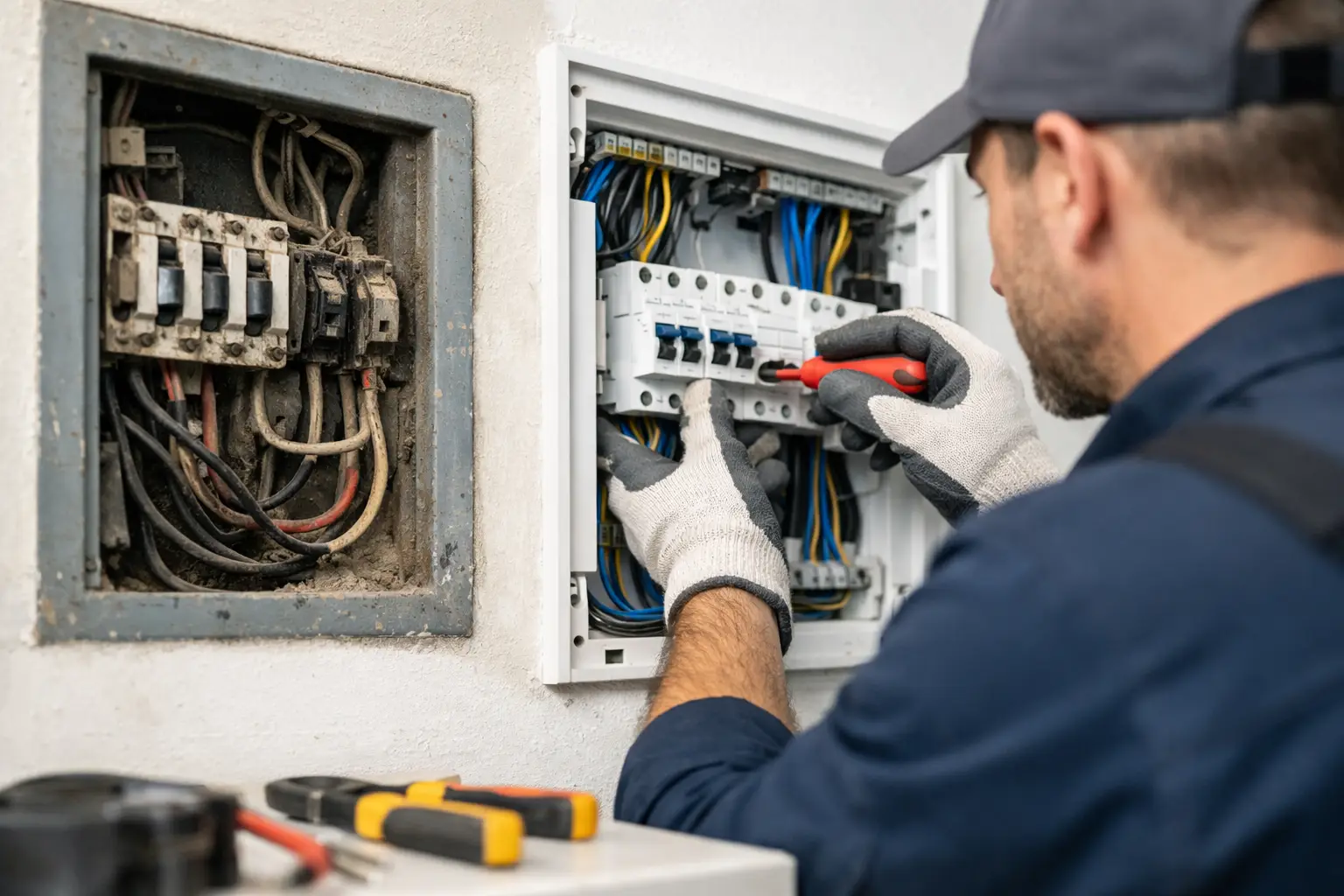
If your lights flicker when the air con starts, your fuses keep blowing, or your switchboard still has ceramic fuses, the question is not whether attention is needed – it is how to upgrade old switchboard equipment safely and properly. For many homes and commercial properties, the switchboard sits out of sight until something goes wrong. By then, you may already be dealing with safety risks, nuisance outages, or a system that simply cannot keep up with modern demand.
A switchboard upgrade is not just about replacing an old box on the wall. It is about bringing your electrical system up to a safer standard, improving reliability, and making sure the property can support the way you actually use power today.
Why old switchboards become a problem
Older switchboards were built for a different era. Homes had fewer power points, fewer large appliances, and no EV chargers, home offices, security systems, induction cooking, or high-load air conditioning. Many commercial sites have also added equipment over time without the original board being designed for that extra load.
The result is a system under pressure. An old switchboard may still function, but that does not mean it is safe or suitable. Deteriorated components, outdated fuse protection, limited circuit capacity, and a lack of safety switches can all increase risk. In practical terms, that can mean electric shock hazards, overheating, fire risk, and frequent interruptions.
It also affects future plans. If you are renovating, adding new circuits, installing solar, fitting an EV charger, or upgrading lighting and security, the switchboard often needs attention first. There is no point investing in new electrical infrastructure if the heart of the system is outdated.
How to tell if you need to upgrade an old switchboard
Some warning signs are obvious. Others are easy to ignore until they become more serious. If your property has ceramic fuses, no residual current devices, scorch marks, buzzing sounds, loose-fitting breakers, or circuits that trip regularly, it is time to have the board assessed by a licensed electrician.
Age matters too, but age alone is not the full story. Some older boards have been partially modified over the years, which can create a patchwork setup with mixed components and inconsistent protection. A board might look acceptable at a glance while still falling short on safety or capacity.
For property managers and business operators, recurring tenant complaints, unexplained power loss, or limitations when adding equipment are often the first signs. For homeowners, it is usually when a renovation starts or a major appliance is installed that the existing board shows its limits.
How to upgrade old switchboard systems the right way
The right approach starts with inspection, not guesswork. A licensed electrician should assess the current switchboard, the condition of the wiring connected to it, the number and type of circuits, and the demands placed on the property. This is where the trade-offs become clear.
In some cases, a straightforward switchboard replacement is enough. In others, the upgrade may also involve circuit separation, mains work, earthing improvements, meter panel changes, or coordination with the energy distributor. If there is older wiring in poor condition, that may need to be addressed as part of the project rather than treated as a separate issue.
A proper upgrade typically involves removing outdated fuse gear and replacing it with modern circuit breakers and safety switches. The board enclosure may also be replaced if it is damaged, non-compliant, or too small for the new layout. Each circuit should be clearly identified, and the finished board should allow safer isolation and easier fault finding.
This is not a DIY job and it is not a shortcut job either. Switchboards are the control point for your entire electrical installation. Good workmanship matters because poor termination, bad labelling, incorrect sizing, or rushed testing can create problems that are harder to detect than the original fault.
What gets replaced during a switchboard upgrade
Every site is different, but most upgrades include the protective devices and internal components that manage circuit safety. Old rewirable fuses are usually replaced with modern breakers. Safety switches are installed to improve personal protection. Neutral and earth bars may be upgraded, and the enclosure itself may be replaced if the existing board has deteriorated or lacks space.
Sometimes the incoming mains or consumer mains also need upgrading to handle current demand safely. That depends on the load requirements and the condition of the existing installation. If you are adding a large new load, such as ducted air conditioning or EV charging, the board has to be sized for today and not just patched for the next six months.
That is why a quote should not be treated as a simple box swap. The quality of the assessment behind the quote is just as important as the hardware being installed.
What to expect during the work
A switchboard upgrade usually requires a planned power shutdown. For homes, this means choosing a time that limits disruption to refrigeration, internet-connected systems, and everyday routines. For commercial sites, timing can be more critical, especially if refrigeration, point-of-sale systems, access control, alarms, or operational equipment are involved.
The electrician will isolate supply, remove the old board components, install the new switchboard setup, reconnect and test circuits, and verify that protection devices are working correctly. If distributor involvement is required, the scheduling may be a little more involved.
A well-managed project should be clearly communicated from the start. You should know what is being replaced, whether any additional defects were found, how long the outage is likely to last, and whether future electrical work will be easier once the upgrade is complete. That level of clarity matters because most customers are not trying to become switchboard experts – they just want to know the property will be safe and dependable.
Cost, compliance, and the temptation to delay
One reason people put off switchboard upgrades is cost. That is understandable. The final price can vary depending on the board size, site access, whether asbestos backing panels are involved, the condition of existing wiring, and whether the mains need upgrading as well.
But delaying can be more expensive than expected. Repeated faults, emergency callouts, damaged appliances, failed tenancy inspections, and limits on future electrical works all add up. More importantly, there is the safety side. An old board may work right up until it does not.
Compliance also matters. Electrical standards are there for a reason, and if you are selling, leasing, renovating, or managing a commercial site, non-compliant electrical infrastructure can quickly become a liability. Insurance concerns may also come into play, particularly where known defects have been ignored.
The best approach is to get a clear assessment and a transparent scope of work. A reliable electrician will explain what is essential now, what may be recommended for future planning, and where there is room to stage upgrades if budgets are tight.
Choosing the right electrician for a switchboard upgrade
When you are comparing providers, look beyond price alone. Switchboard work demands licensing, experience, careful testing, and an understanding of both current standards and real-world site conditions. The right electrician should be able to explain the risks, the options, and the expected outcome in plain language.
Responsive communication is a good sign. So is a detailed quote, warranty-backed workmanship, and a willingness to inspect the existing setup properly before making promises. For homes, that means confidence that the family is safe. For businesses and property managers, it means fewer disruptions and less chance of repeat issues.
At Voltricity, switchboard upgrades are approached the same way all critical electrical work should be approached – with safety first, clear advice, and workmanship that is built to last. That matters whether you are updating a family home, preparing a rental for new tenants, or making sure a commercial premises can support growing demand.
Is now the right time to upgrade?
If your board is visibly outdated, lacks safety switches, struggles with modern loads, or keeps giving you reasons to worry, waiting rarely improves the situation. The right time to upgrade is usually before the next fault, before the renovation starts, and before new equipment is installed.
A switchboard should not be something you have to think about every week. When it is upgraded properly, the benefit is not just compliance on paper. It is the confidence that your property has safer protection, better reliability, and room for what comes next.