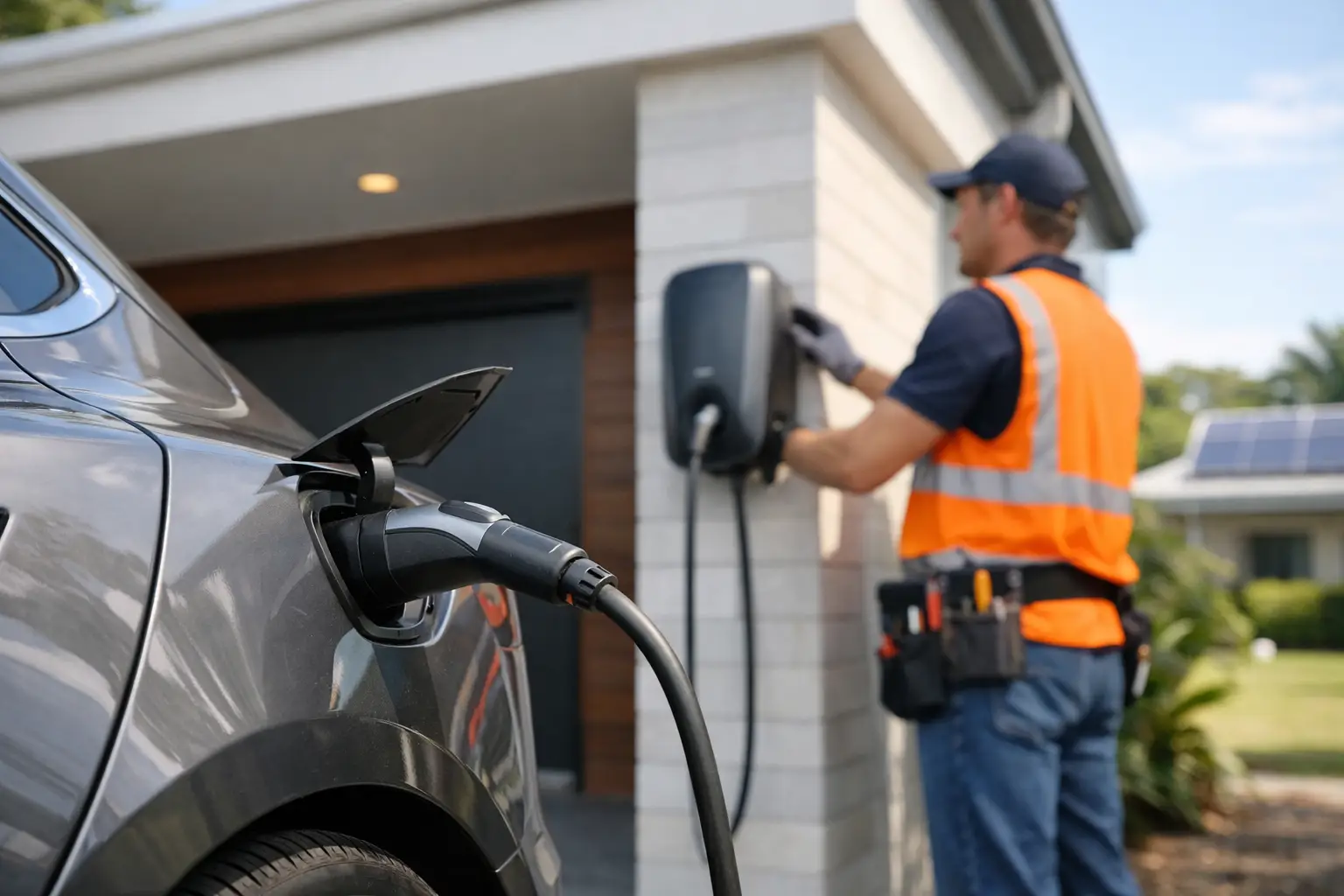
A home EV charger can make the daily drive far simpler, but the charger on the wall is only one part of the job. A safe EV charger installation guide starts with your property’s electrical capacity, where the vehicle parks and how you actually use it. Get those decisions right first and you can charge reliably overnight, protect your electrical system and avoid paying to relocate or upgrade equipment later.
For homeowners, property managers and businesses, the goal is not simply to install the fastest charger available. It is to install a charging solution that suits the vehicle, site and future demand while meeting Australian electrical safety requirements.
Start with your charging habits
Before choosing equipment, consider how far the vehicle travels on an average day and how long it is normally parked at home or at work. Most drivers do not need to replenish a full battery every night. If a car is parked for eight to 10 hours, a correctly selected AC charger will usually provide more than enough energy for everyday driving.
A dedicated wall-mounted charger is generally more convenient and durable than relying on a portable charging lead. It can also offer scheduled charging, load management and app controls, depending on the model. Scheduling is useful when you want to make the most of off-peak electricity periods or solar generation.
The vehicle’s onboard charger also matters. A unit capable of higher output will not necessarily charge your EV faster if the vehicle accepts less power. This is why the charger should be selected around the car and the property, not just the biggest number on the box.
EV charger installation guide: assess the electrical supply
Your electrician should inspect the switchboard and existing electrical load before recommending a charger size. EV charging is a substantial, sustained load, particularly when it runs overnight alongside heating, cooling, cooking, hot water and pool equipment.
Many Australian homes have single-phase power. A 7 kW charger is a common choice where the supply and switchboard capacity allow it. Properties with three-phase power may have more options, including 11 kW or 22 kW charging, but the best option still depends on the vehicle, available supply and the household’s maximum demand.
Older switchboards deserve particular attention. Ceramic fuses, limited circuit space, ageing cabling or inadequate safety switches may mean a switchboard upgrade is needed before the charger can be connected. This is not an unnecessary add-on. The charger needs a correctly sized dedicated circuit, suitable circuit protection and installation that complies with applicable Australian standards and manufacturer requirements.
Load management can prevent costly upgrades
In some homes, the available supply is close to its practical limit at busy times. Load management allows the charger to reduce or pause charging when other major appliances are running, then resume when capacity is available. It can be a sensible alternative to a larger supply upgrade, especially for homes with ducted air conditioning, electric cooking or multiple high-load appliances.
It does involve a trade-off. Charging may be slower at peak household-use times, but for vehicles parked overnight that often makes little difference. Your electrician can assess whether a fixed charging rate or dynamic load management is the better fit.
For commercial sites, the calculation is broader. Existing building demand, tenancy arrangements, operating hours, future chargers and electricity metering all need to be considered. Installing one charger without a plan for the next five can create avoidable disruption when the site expands.
Choose a location that works every day
The most practical charger location is usually near the regular parking position, with the cable able to reach the vehicle inlet without stretching across a walkway, driveway or footpath. The cable should be easy to manage and protected from damage when not in use.
In a garage, that might mean installing the unit beside the driver’s door or near the front of the vehicle. On an external wall, the charger should be rated and installed for the conditions it will face, including weather, heat, water exposure and potential impact. A driveway location may require extra protection from vehicles.
Cable route has a direct effect on cost. A charger mounted close to the switchboard is often simpler and less expensive to install than one on a detached garage, carport or far end of a long driveway. That does not mean the nearest location is automatically best. A neat, protected cable route and a charger that is genuinely convenient to use are worth planning for.
For apartment buildings and strata properties, installation requires more coordination. The parking bay may be common property, supply capacity may be shared, and approval requirements can apply. Property managers should establish a consistent approach early, including who owns the charger, how electricity is measured and how future requests will be handled.
Select charger features that match the site
Most residential charging decisions come down to a tethered or untethered unit. A tethered charger has a fixed cable, which is quick and convenient for daily use. An untethered charger has a socket instead, allowing the driver to use their own cable and potentially making the unit more adaptable if vehicle connection types change.
Smart features can be worthwhile where they solve a real problem. Scheduled charging can support electricity tariff planning, solar-aware charging can help use available rooftop generation, and access controls can be useful at workplaces or shared car parks. For a single household with predictable charging, a dependable unit with the right electrical design may be more valuable than a long feature list.
When comparing chargers, check the warranty, local support, weather rating, cable length and compatibility with your vehicle. Avoid treating a charger as a plug-and-play appliance. The equipment, electrical protection and installation method work together as one system.
What a licensed installation should include
EV charger work must be completed by a licensed electrician. Aside from the legal and safety obligations, a professional installation gives you confidence that the charger has been assessed, installed, tested and commissioned correctly.
A thorough job generally includes an on-site assessment, a review of the switchboard and supply, confirmation of the charger location, installation of a dedicated circuit and required protection, secure mounting, cable containment where needed, testing and clear handover. Your electrician should also explain basic operation, scheduled charging settings and what to do if the unit indicates a fault.
Ask for transparent pricing that identifies any likely variables. A straightforward installation may be priced differently from work involving long cable runs, trenching, a detached structure, switchboard upgrades, three-phase alterations or load-management equipment. A clear quote helps you compare scope, not just the lowest initial figure.
Avoid DIY and improvised charging setups
Using extension leads, adapting outlets or asking an unlicensed person to add a circuit can create serious risk. EVs draw power for long periods, so poor connections and undersized wiring can overheat. A dedicated, professionally installed charger is designed to provide a safer and more reliable daily solution.
Portable charging equipment can be useful when travelling or as a temporary option, but it should only be used as intended by the vehicle manufacturer and connected to an appropriate outlet. If you are relying on it every day, it is time to discuss a permanent installation.
Plan for solar, batteries and the next vehicle
An EV charger can work well alongside solar, but solar panels do not automatically mean free charging. Generation varies with weather, season and the time the vehicle is parked at home. Smart charging may allow the vehicle to increase charging when surplus solar is available, while scheduled overnight charging may still be the most practical routine for many households.
If you are considering a home battery, renovation, pool equipment or a second EV in the next few years, mention it during the assessment. Planning for spare switchboard capacity, a suitable cable route or scalable load management can save time and expense later.
The same forward planning matters for businesses. A staged rollout with capacity for future charging is often more cost-effective than repeating major electrical works every time another staff member, tenant or fleet vehicle needs a charger.
A quality EV charger installation is a practical property upgrade, not a one-size-fits-all purchase. A licensed electrician can assess the supply, recommend a suitable charger and complete the work with the care your home or business deserves. Voltricity can help you move from parking plans to a safe, dependable charging point with clear advice and professional workmanship.