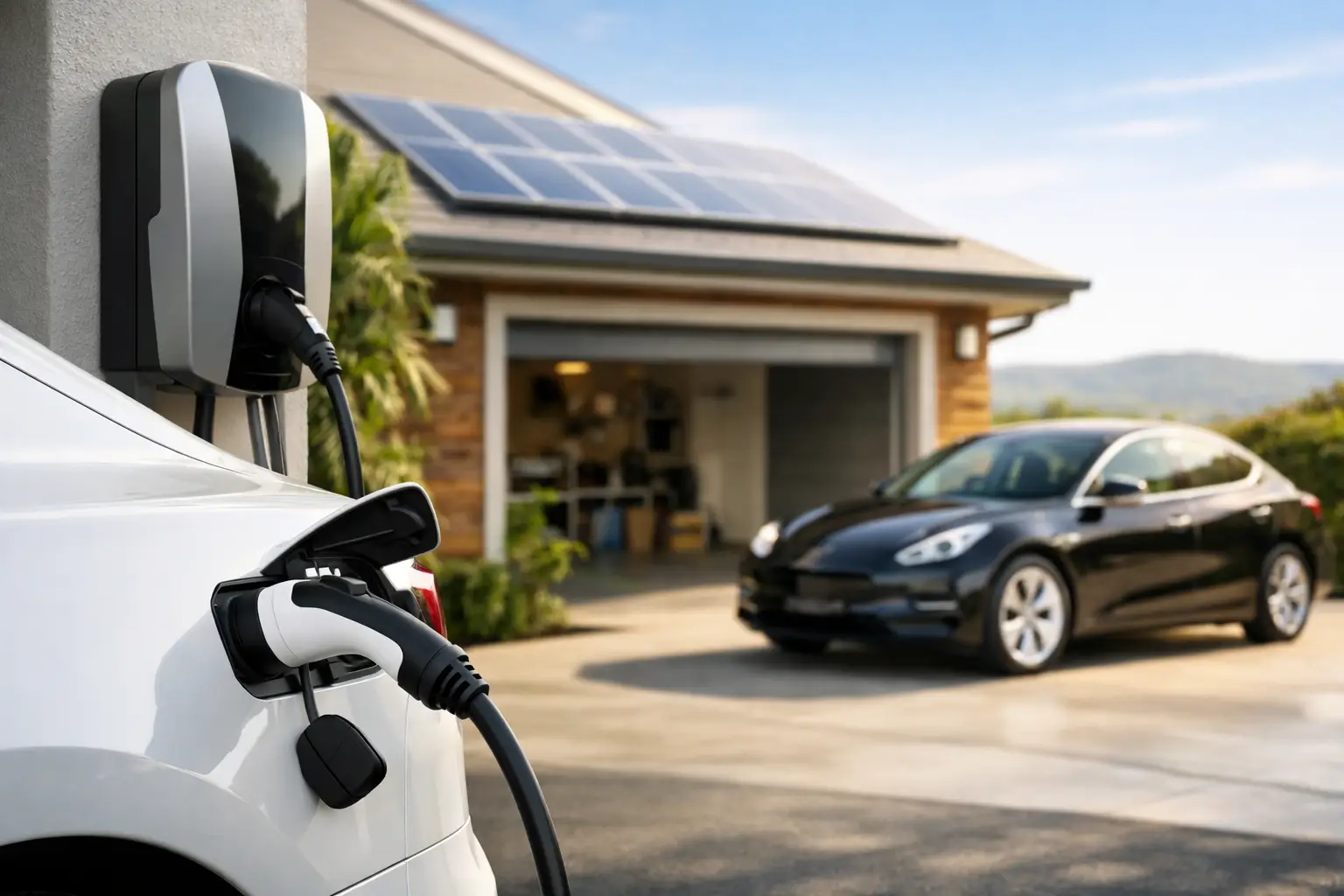
A new EV changes the way your home uses electricity. Instead of planning fuel stops, you can wake up to a charged vehicle each morning – provided the charger, switchboard and wiring have been selected for the way you actually drive. The best home EV charger setups are not always the fastest or most expensive. They are the ones that safely suit your vehicle, electrical supply, parking arrangement and household energy use.
For most Australian homes, a professionally installed wall charger offers a safer, more dependable solution than relying on a standard power point. It gives you predictable charging, protects your electrical system and can be configured to make the most of off-peak tariffs or rooftop solar.
Start with the way you use your EV
Before choosing a charger, consider how far you drive on a typical day and how long the car will be parked at home. A household that drives 30 to 60 kilometres most days has very different needs from a family running two EVs, or a business owner taking a vehicle interstate each week.
For many homes, overnight charging is the practical advantage. A charger does not need to refill the battery from empty every night. It simply needs to restore the energy you used during the day while the car is parked. That often makes a 7 kW single-phase charger an excellent fit, even where a higher-powered option is available.
Your vehicle also has a say. The car’s onboard AC charging capability sets the maximum rate it can accept from a home charger. Installing a 22 kW unit will not make a vehicle that accepts 7 kW charge any faster. Checking the vehicle specification before installation prevents unnecessary spend and helps set realistic expectations.
Best home EV charger setups by property type
There is no one-size-fits-all answer, but these four arrangements cover the needs of most Australian properties.
- Single-phase 7 kW wall charger: A strong all-round choice for many detached homes. It can add useful range overnight and is usually suitable for daily driving, provided the home has sufficient electrical capacity.
- Three-phase 11 kW or 22 kW charger: Best suited to homes with three-phase power, compatible vehicles and higher daily kilometre requirements. This can be particularly helpful for households with more than one EV, although 22 kW charging depends on the car being capable of accepting it.
- Smart charger with load management: Ideal where the home has air conditioning, electric cooking, a pool, battery storage or other high-demand appliances. The charger adjusts its draw to help avoid overloading the main supply.
- Solar-aware charger: A practical option for homes with solar panels and flexibility around charging times. It can prioritise available solar generation, reducing grid use when the sun is out.
A qualified electrician should assess the property before recommending any of these options. The right setup is based on more than the charger itself. Cable route, distance from the switchboard, supply capacity, local requirements and future plans all affect the final design.
Charging speed matters, but capacity matters more
It is easy to focus on kilowatts, but the home electrical system is the real starting point. A dedicated EV charger is a significant load, particularly when it operates at the same time as ducted air conditioning, an oven, hot water, a clothes dryer or pool equipment.
A licensed electrician can inspect your switchboard, main supply and existing circuits to determine whether the charger can be installed as planned. Some properties need only a dedicated circuit and appropriate protection. Others may require a switchboard upgrade, load management equipment or a discussion with the electricity distributor about supply capacity.
This is not a corner worth cutting. EV charging involves sustained high current over long periods, so the installation needs suitable cabling, protection devices, earthing and isolation in line with applicable Australian standards. A charger should be installed by a licensed electrician, not connected through improvised leads or an unsuitable existing outlet.
For older homes, the inspection can uncover other worthwhile improvements. Ceramic fuses, overcrowded switchboards, limited spare capacity or ageing wiring may not prevent you from owning an EV, but they should be addressed before adding a major new electrical load.
Choose a location that works every day
The best location is usually the one that makes charging effortless. For a garage, that may mean mounting the unit near the driver’s side charging port, with the cable able to reach the vehicle without becoming a trip hazard. In a carport or driveway, weather rating, mounting security and cable management become even more important.
Think about how you park, not just where there is a convenient wall. If different family members reverse in on some days and drive in on others, a centrally placed unit or a longer lead may make more sense. The cable should not run across a footpath, accessway or area where it can be damaged by tyres, doors or garden equipment.
A longer cable route from the switchboard can increase installation cost, especially where wiring needs to pass through walls, under floors or across a large property. That does not automatically make a closer location the better choice. A clean, safe installation that you will use comfortably every day is usually worth planning properly from the start.
For strata properties and apartment buildings, the process can be more involved. Shared electrical infrastructure, parking allocations, owners corporation approval and metering arrangements may all need attention. A site assessment can clarify what is feasible and help create a solution that works for the building as well as the individual resident.
Smart controls can reduce running costs
A smart charger gives you more control over when and how your EV charges. Depending on the model and tariff, you may be able to schedule charging for off-peak periods, monitor energy use and adjust settings from your mobile. This is useful for households trying to manage electricity bills without changing their daily routine.
Solar integration can also be worthwhile, but it is not magic. Solar production is highest during the middle of the day, while many vehicles are away from home. It works especially well for people who work from home, have a vehicle parked during daylight hours or can schedule charging around weekend use. If your EV arrives home after sunset, an off-peak schedule may be more practical than waiting for solar power.
Load balancing is one of the most valuable smart features for busy homes. Rather than requiring every appliance to be switched off, the charger can reduce or pause charging when household demand is high, then resume when capacity is available. It helps protect the supply while keeping the vehicle ready for the next trip.
Plan for the next vehicle, not just this one
EV ownership is changing quickly. A charger that is right for one vehicle today may need to support a second EV, a future renovation, solar battery storage or a different electricity tariff in a few years. Allowing for spare switchboard capacity, a sensible cable route and compatible smart controls can make later upgrades simpler.
That does not mean paying for maximum capacity you will never use. It means making informed choices. A 7 kW charger with load management may be a better long-term investment than an oversized charger that pushes an older electrical system beyond its comfort zone.
At Voltricity, our licensed electricians assess the full installation, not just the box on the wall. We look at your home supply, switchboard, parking area and charging routine, then provide clear advice on a safe, practical setup.
A well-planned home charger should fade into the background: you park, plug in and get on with your evening. Start with an electrical assessment, choose a setup that fits your real driving habits, and you will have charging that feels dependable from the first morning onward.