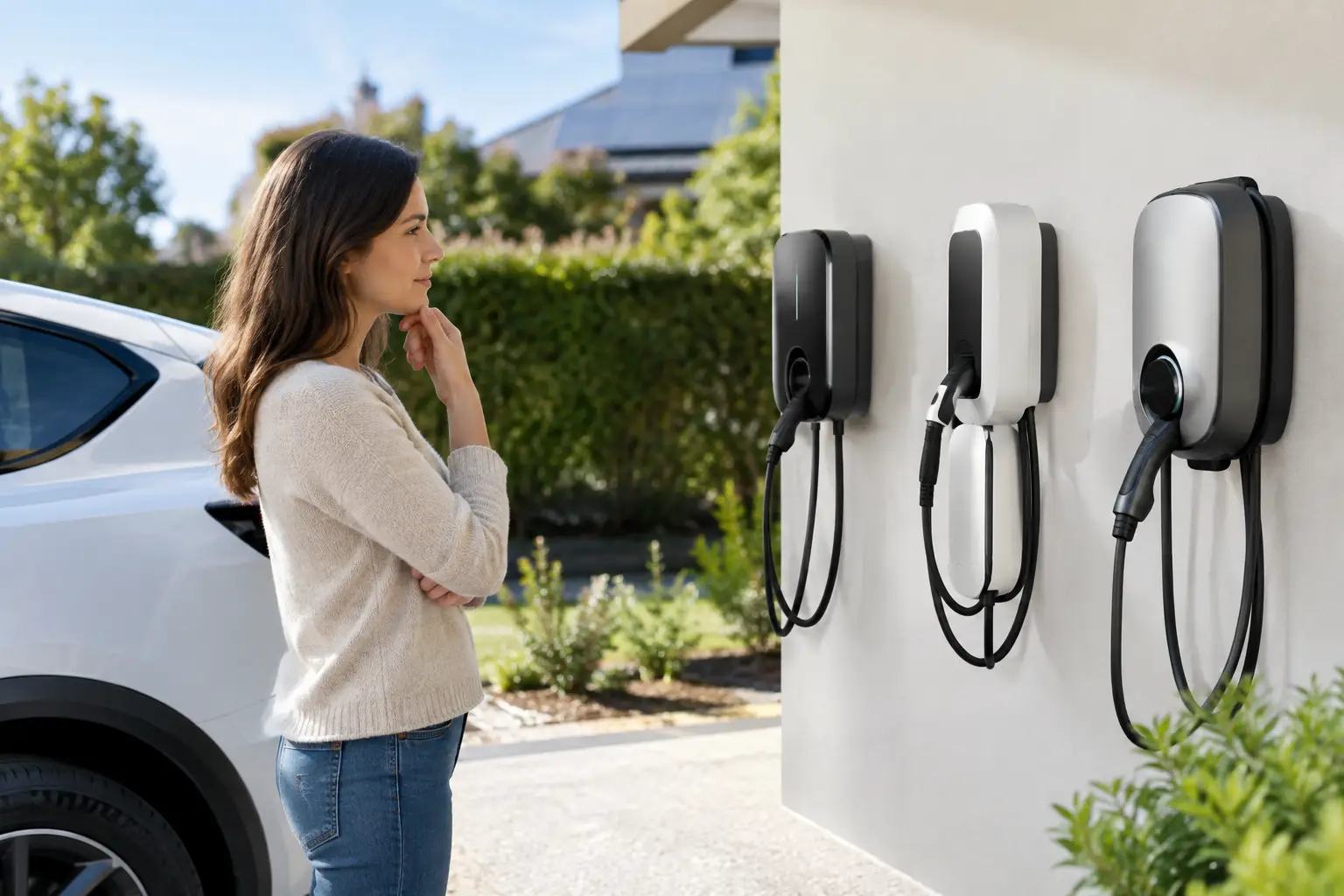
A public charger is useful when you are travelling. At home or at work, it should not be your main charging plan. The right EV charger lets your vehicle charge while it is parked, ready for the morning commute or the next day’s appointments. This EV charger comparison focuses on the decisions that affect daily convenience, installation cost and long-term safety.
The best unit is not automatically the fastest or the one with the longest feature list. It needs to suit your vehicle, driving habits, electrical supply and the capacity available in your switchboard. Getting those fundamentals right produces a charging setup you can rely on for years.
EV charger comparison: start with charging speed
For most Australian households, a dedicated AC wall charger is the practical choice. These chargers are designed for regular use and are usually installed in a garage, carport or driveway close to where the vehicle is parked.
A 7 kW single-phase charger is a common option. Subject to your vehicle’s onboard charger and your home’s electrical capacity, it can add roughly 40 to 50 kilometres of range per hour. For many drivers, that is more than enough to replenish a typical day’s travel overnight.
Three-phase properties may be able to support 11 kW or 22 kW charging. An 11 kW charger can be a good match for households with higher daily kilometres, multiple EVs or shorter periods at home. A 22 kW charger sounds appealing, but it only delivers its full potential if the car can accept 22 kW AC charging and the property has sufficient three-phase capacity. Many EVs have lower onboard AC charging limits, so paying for a larger charger may not produce a faster charge.
Portable charging cables supplied with some vehicles can plug into a standard power point. They are useful as a backup, but they are generally slow and should not be treated as a permanent solution for daily charging. Long, continuous electrical loads need the right circuit, protection and connection point. A dedicated wall charger gives you a safer, more convenient arrangement.
DC fast chargers are the units commonly found at public charging sites. They can charge quickly, but their cost, electrical demand and installation requirements put them beyond what most homes need. They are more relevant to selected commercial sites, fleets and destinations where rapid turnover is a business requirement.
Check the vehicle before choosing the charger
Your EV’s charging port, onboard AC charging limit and battery size all matter. In Australia, many newer vehicles use a Type 2 AC connection, while charging speeds vary widely between models. The wall charger may be rated at 11 kW, for example, but a vehicle limited to 7 kW AC will still charge at 7 kW.
Battery size also changes what feels fast enough. A driver covering 30 kilometres each day has very different needs from a salesperson travelling 200 kilometres most days. Overnight charging with a 7 kW unit suits the first driver comfortably. The second may benefit from higher-capacity charging, workplace charging or a combination of home charging and public infrastructure.
It is also worth planning for the next vehicle, not only the current one. If a household expects to replace a second car with an EV within a few years, choosing a charger platform that can manage two vehicles may avoid reworking the installation later.
The electrical installation is as important as the charger
A wall charger is not a plug-and-play appliance. It should be installed by a licensed electrician who assesses the property rather than simply mounting the unit where it looks convenient.
The assessment should consider the switchboard, existing electrical load, cable route, charger location, earthing, circuit protection and the available supply capacity. Older homes may have limited switchboard space or an outdated board that requires upgrades before an EV charger can be installed properly. This does not mean every property needs a major upgrade, but it should be identified before work begins, not after the charger has been purchased.
Location matters as well. The cable needs to reach the vehicle without becoming a trip hazard across a walkway. Outdoor installations require equipment suited to weather exposure, while shared or strata parking areas may require approvals and careful planning around access, metering and cable pathways.
For commercial properties, the question is often larger than one parking bay. A business may need to consider visitor charging, staff access, billing, future expansion and the building’s maximum electrical demand. A staged installation can be sensible: install infrastructure that supports future chargers, then add units as demand grows.
Smart features that genuinely earn their place
Smart chargers can make charging easier to manage, but not every feature will matter to every owner. The most useful functions tend to be those that reduce running costs or prevent unnecessary electrical upgrades.
Scheduled charging allows the vehicle to charge during off-peak periods where your electricity plan makes that worthwhile. It also means the car can be plugged in after work without starting a full charge immediately.
Load management is particularly valuable in homes with limited supply capacity. The charger monitors or responds to household demand and reduces its charging rate when high-load appliances are operating. When demand drops, charging can increase again. This can help avoid overloading the property and may reduce the need for a costly supply upgrade.
Solar-aware charging is another worthwhile option for homes with solar panels. Depending on the charger, inverter and setup, it can prioritise available solar generation or charge during selected solar windows. It is not always the cheapest choice, especially if feed-in tariffs, electricity rates and driving patterns do not align. However, it can be an excellent fit for households where a vehicle is parked at home during the day.
For businesses and shared sites, user access and reporting may be more important than solar integration. RFID access, usage tracking and the ability to allocate charging costs can provide greater control. The key is to choose features that solve a real operational need rather than paying for an app that will rarely be opened.
Single-phase versus three-phase charging
Single-phase power is common in Australian homes and can support a highly effective EV charging setup. A 7 kW charger is often the sensible balance between overnight charging speed, installation cost and available electrical capacity.
Three-phase power can support faster AC charging and may be worthwhile for larger homes, high-use vehicles and commercial properties. It can also make future expansion easier where multiple chargers are planned. But three-phase is not automatically better. If the car cannot accept the higher rate, or if the vehicle is parked overnight every day, the practical benefit may be small.
A good decision starts with the time available to charge. If your vehicle is typically parked for 10 to 12 hours overnight, even moderate charging capacity can meet your needs. Faster charging matters most when parking windows are short or daily travel is consistently high.
Compare total value, not just the unit price
When comparing chargers, look beyond the purchase price. The total cost includes the charger, cable run, mounting, dedicated circuit, switchboard work if needed, protection devices and commissioning. Difficult access, long cable routes and underground works can also affect the final quote.
The cheapest unit can become the expensive option if it lacks the functions you later need, has poor local support or is not suitable for the site. At the same time, the most premium charger may be unnecessary for a household that charges one EV overnight and has no plans for solar integration or a second vehicle.
Warranty terms and after-sales support deserve attention. Ask what is covered, how faults are handled and whether the manufacturer has a practical support presence in Australia. Charging equipment is intended for frequent, long-term use, so reliability and serviceability matter more than a flashy display.
A practical way to make the decision
Start with your daily kilometres and when the vehicle is normally parked. Then confirm the vehicle’s AC charging limit, the property’s electrical supply and whether you expect another EV in the near future. From there, decide whether scheduled charging, solar integration, load management or access control will make a measurable difference.
For many homes, a quality 7 kW smart charger installed on a dedicated circuit is the right answer. For three-phase homes, busy households and commercial sites, an 11 kW or expandable managed setup may offer better value. Voltricity can assess the charger location, existing electrical infrastructure and future requirements so the installation suits the property, not just the vehicle.
The most useful charger is the one that fits naturally into your routine, charges safely when you need it and leaves room for how your property may change next.