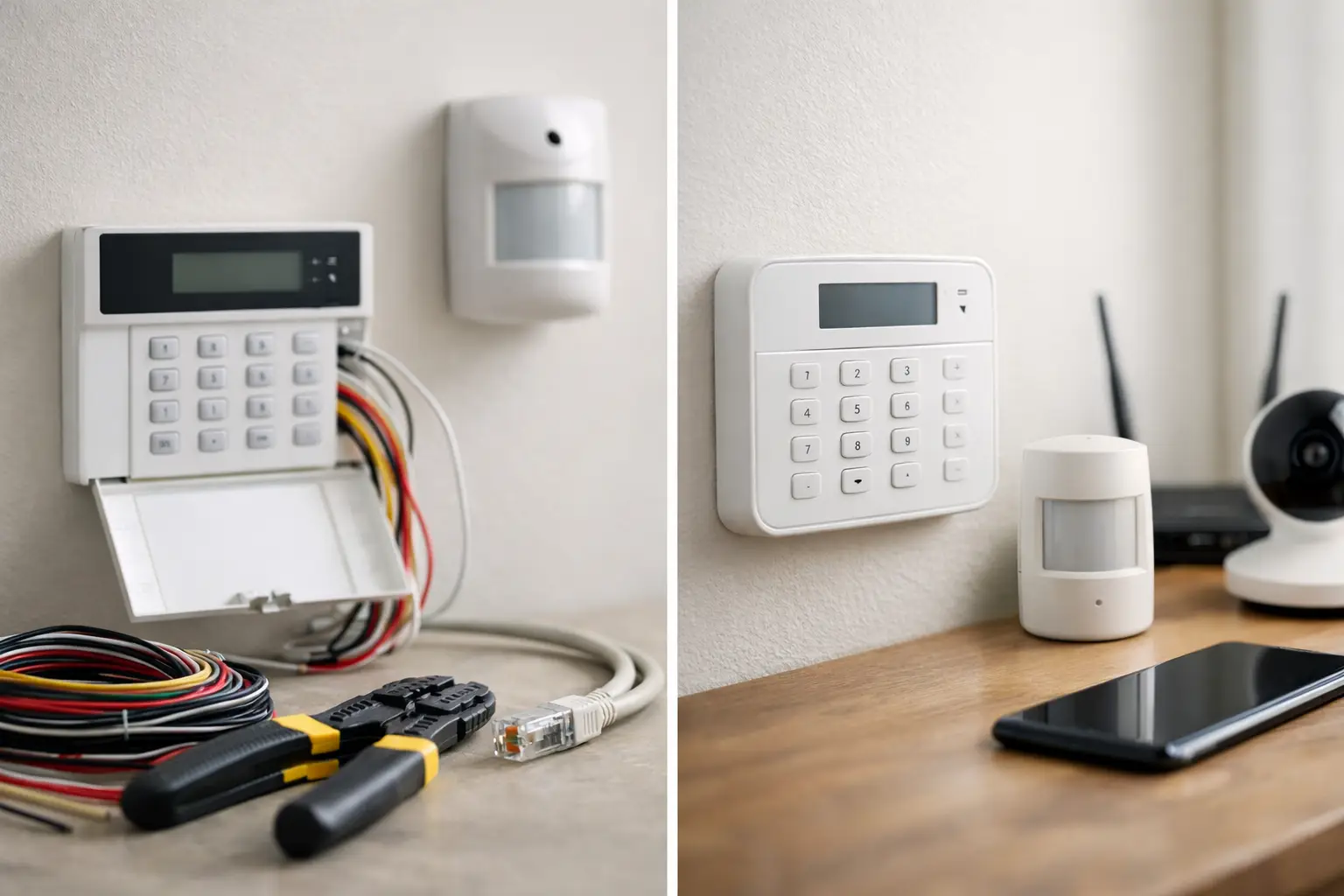
A security alarm is only useful if it is armed, powered and capable of raising the alert when it matters. That is why the wired vs wireless alarms decision should start with your property, daily routine and level of risk – not simply the lowest installation price.
For a newly built home, a busy retail shop or a commercial site with fixed operating hours, a wired system may offer the long-term certainty you want. For an established house, rental property or premises where opening walls is impractical, wireless equipment can deliver strong protection with far less disruption. The right answer is often more practical than technical.
Wired vs wireless alarms at a glance
A wired alarm system connects sensors, keypads, sirens and other components to the control panel with physical cabling. Most devices receive power through those cables, while the main panel has a backup battery to keep operating during a power outage. Because each device is hardwired, the system does not rely on a radio signal between the sensor and panel.
A wireless alarm system uses radio communication between its devices and the control panel. Sensors are battery-powered, so they can be positioned without running new cables through ceilings, walls or floor cavities. Modern wireless systems can include door contacts, motion detectors, panic buttons, sirens, app access and professional monitoring options.
Both can be highly effective when they are properly designed, installed and maintained. The difference comes down to reliability requirements, building access, future changes and how much ongoing maintenance you are comfortable managing.
When a wired alarm makes more sense
Wired alarms are a strong choice for new builds, major renovations and commercial fit-outs. When walls and ceilings are already open, running alarm cabling alongside electrical work is usually more efficient and keeps the finished installation neat. Sensors can be placed exactly where they are needed without concern about battery access or wireless signal range.
For larger premises, wired systems are often easier to scale. A warehouse, office, medical practice or multi-room retail space may have many access points, internal zones and areas that need different arming schedules. Hardwired devices provide consistent communication across the site and reduce the number of batteries that need scheduled replacement.
They are also well suited to properties where long-term reliability is the priority. Wired sensors do not depend on individual batteries, and the physical cable connection is not affected by typical radio interference from nearby equipment. A backup battery at the alarm panel remains essential, as it supports the system if mains power is interrupted.
The trade-off is installation complexity. Retrofitting cables into an existing home or finished business can involve roof access, wall penetrations, patching or surface conduit in some areas. The labour cost can be higher, particularly in double-storey buildings, concrete construction or sites with limited ceiling access.
Benefits of a wired system
A wired alarm typically offers dependable device communication, minimal sensor battery maintenance and a discreet finish when installed during construction. It can also be a sensible foundation for an integrated security plan that includes access control, CCTV and monitored alarm reporting.
That does not mean wired is automatically better. If installing cables requires significant building work, the extra cost and disruption may outweigh the benefits for your particular property.
When wireless alarms are the practical choice
Wireless alarms are designed for flexibility. They are particularly useful in established homes where you want stronger security without cutting into plasterboard or lifting flooring. A sensor can be fitted to a door, window or room with considerably less disruption than a hardwired alternative.
This flexibility is valuable for property managers and business operators too. If a tenancy changes, an office layout is reconfigured or a storage area is added, wireless sensors can often be relocated or expanded more easily. For homes, wireless systems can make it simpler to protect a detached garage, shed or granny flat, provided the signal path is confirmed during design.
Modern wireless equipment is far more capable than the basic DIY kits many people picture. Professionally specified systems can supervise device communication, report low batteries and send alerts through an app or monitoring service. However, quality matters. Devices need to be compatible, installed within their rated range and tested in the real conditions of your property.
Wireless alarms do require a maintenance routine. Each sensor battery has a service life, but it will vary based on the device, usage, temperature and signal conditions. A low-battery notification is helpful, but it is not a substitute for arranging replacement promptly. A sensor with a flat battery cannot protect its zone.
Common wireless considerations
Radio performance can be affected by distance, metal framing, concrete walls, foil insulation and other electronic equipment. A good installer checks communication strength rather than assuming every corner of the building will perform the same way. The control panel, communication module and external siren also need careful placement to reduce the opportunity for tampering.
Wireless systems are not inherently less secure than wired ones. They use supervised communication and security features designed to identify faults or interference. Still, a professionally installed system with correct device placement is a better investment than a collection of off-the-shelf sensors fitted without a site assessment.
Installation cost is only part of the decision
Wireless alarm installation is often less expensive upfront because there is less cable running and less making good after the work. That can make it attractive for an existing home or a small business that needs protection quickly.
Wired systems can cost more to install, especially as a retrofit, but may have lower device maintenance costs over time. The real comparison is not only the quote you receive today. Consider the likely life of the system, whether the building will be renovated, how often the layout changes and whether you want to add cameras, access control or monitoring later.
For example, a homeowner planning a full renovation may save money by including alarm cabling in the electrical scope now. A business moving into a leased office for three years may prefer a wireless system that can adapt to the tenancy and potentially move with the business.
Power, communications and monitoring matter
Whether an alarm is wired or wireless, the panel needs a reliable power supply and battery backup. It also needs a way to notify you or a monitoring centre when an alarm activates. That may be through a mobile communications module, internet connection or a combination of communication paths.
Do not assume a home internet connection alone is enough for every site. Consider what happens if the modem loses power, the internet service fails or an intruder damages accessible cabling. The appropriate setup depends on the risk level of the property and the response you need after an alarm event.
For commercial premises, monitoring procedures deserve as much attention as the hardware. Decide who receives alerts, who can attend after hours, how keys or access codes are managed, and what happens if an alarm is activated repeatedly. An alarm system is part of a security process, not a replacement for one.
A hybrid system may give you the best result
The choice does not always have to be entirely wired or entirely wireless. Hybrid alarm panels can support both types of devices. This approach works well when a property has existing alarm cables in usable locations but needs extra protection in areas where running new cable would be difficult.
You might use wired contacts on frequently used doors, fixed motion sensors in main internal areas and wireless devices for a garage, extension or difficult-to-reach window. A hybrid design can also help stage security upgrades, allowing the system to grow as your needs and budget change.
Choose the system around your property, not the box
Before selecting equipment, walk through the property with a security professional and identify how someone could gain entry, which areas hold valuable stock or personal items, and how occupants move through the building. Consider pets, large windows, external doors, roller shutters, detached structures and after-hours access requirements.
If your project also involves new wiring, a switchboard upgrade, CCTV, lighting or access control, coordinating the work can avoid duplicated labour and leave you with a more considered result. Voltricity can assess the electrical and security requirements together, then recommend an alarm layout that suits the building rather than forcing a one-size-fits-all package.
The best alarm is the one that fits the property, is straightforward to use and is maintained properly. Choose a system you will arm every day, test regularly and trust when the building is empty.