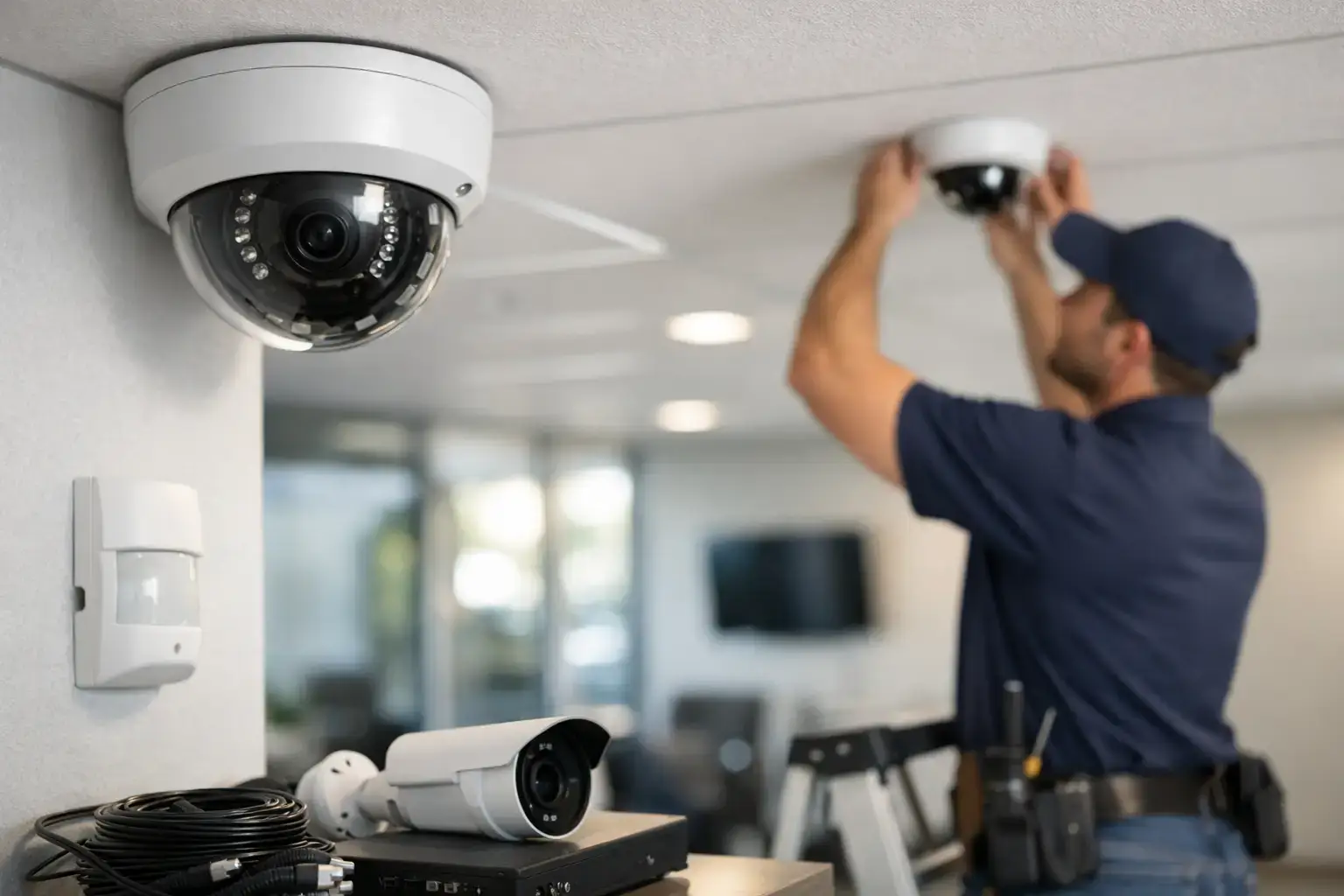
A business owner usually notices security gaps at the worst possible time – after a break-in, after stock goes missing, or after staff raise concerns about who can access the site. Good commercial security system installation is about fixing those gaps before they become expensive problems. It is not just a matter of putting cameras on walls. The right setup needs to suit the building, the way your team works, your risk level, and the electrical infrastructure already in place.
For shops, offices, warehouses, medical suites, schools, and mixed-use sites, security works best when it is planned as part of the property itself. That means thinking about surveillance, access control, alarms, lighting, cabling, power supply, and user access as one connected system. When each part is selected and installed properly, you get a site that is easier to manage, safer for staff and visitors, and far less vulnerable to avoidable incidents.
What commercial security system installation should include
A proper commercial security system installation starts with a site assessment. Every premises has different entry points, blind spots, operating hours, and exposure to risk. A retail tenancy has different needs from a warehouse with roller doors and loading zones. Likewise, a small office with ten staff should not be treated the same way as a multi-tenant building with shared access areas.
At the planning stage, the aim is to answer practical questions. Where do people enter and exit? Which areas hold stock, equipment, cash, records, or sensitive information? Are there car parks, external walkways, or rear service areas that need visibility after dark? Is the building already cabled for data and power in a way that supports security devices, or will upgrades be needed?
Most commercial systems are built around three core functions. Cameras provide visibility and recorded footage. Access control restricts who can enter particular areas and when. Intruder alarms alert you when there is unauthorised activity. In many cases, these are supported by security lighting, intercoms, remote viewing, and backup power so the system remains useful during outages or after hours.
Why planning matters more than product hype
It is easy to get distracted by high-spec cameras or app features. In practice, the value of a security system usually comes down to coverage, reliability, and usability. A premium camera placed in the wrong position will still miss key activity. An access system that is confusing to manage will often be bypassed. An alarm that throws false alerts too often tends to get ignored.
That is why layout matters more than marketing claims. Camera angles need to capture faces at entries, vehicle movement where relevant, and activity in high-risk areas without leaving dead zones. Access readers need to be placed where they support traffic flow rather than slowing everyone down. Alarm devices need to suit the environment, whether that means motion detection in internal spaces or perimeter protection for external points of entry.
There is also a balance to strike between security and convenience. A tightly locked-down site may sound ideal, but if it makes daily operations harder, staff will look for workarounds. On the other hand, a system that is too loose can leave obvious gaps. The best installations are the ones that support the way a business actually runs.
Commercial security system installation and electrical work
This is the part many property owners underestimate. Security systems depend on sound electrical and cabling work. Cameras, control panels, recording devices, network switches, access readers, electric strikes, sensors, and backup units all need reliable power and proper installation.
If the site has ageing switchboards, overloaded circuits, poor cable pathways, or patchy external lighting, those issues can affect system performance. In some buildings, a security upgrade becomes the point where broader electrical problems come to light. That is not necessarily bad news. It is often better to identify those issues before the system goes live rather than chase faults later.
Working with a provider who understands both security and electrical infrastructure can make the process smoother. It reduces the risk of fragmented work, avoids finger-pointing between trades, and helps ensure the final setup is safe, compliant, and built to last. For many businesses, that joined-up approach is the difference between a neat installation and an ongoing maintenance headache.
Choosing the right components for your site
CCTV is often the first thing business owners ask about, but not every camera setup is equal. Resolution matters, but so do lens type, low-light performance, storage capacity, and placement height. A camera watching a front counter has a different job from one covering a car park or warehouse aisle. Good footage should be useful, not just available.
Access control is where many commercial sites see the biggest day-to-day benefit. Instead of relying on physical keys that can be copied, lost, or never returned, businesses can issue controlled credentials to staff and contractors. Access can be limited by area or time of day, and permissions can be changed quickly when roles change. For offices, apartment common areas, storerooms, and restricted work zones, that control is often more valuable than people expect.
Alarm systems still play an important role, particularly for after-hours protection. The right setup depends on the building layout and how the site is used. Some businesses need full arming outside business hours. Others need partial arming so cleaners, night staff, or delivery teams can still move through approved areas. That is where careful programming matters.
Compliance, privacy, and practical risk
Commercial security is not only about equipment. It also involves legal and operational responsibilities. If you are recording staff, visitors, customers, or shared areas, privacy considerations need to be handled properly. Signage, footage access, retention periods, and internal policies should all align with how the system is being used.
There are also workplace safety considerations. A poorly installed camera or access device is not just untidy – it can become a hazard or a point of failure. Cabling should be protected, equipment should be fitted securely, and any integration with doors, gates, or emergency egress needs to be set up correctly.
For strata managers and commercial landlords, these details matter even more. Shared buildings often involve multiple users, competing access needs, and a higher standard of accountability. What works in a standalone tenancy may not suit a common entry, basement, or plant room serving several occupants.
What a smooth installation process looks like
A well-run project should feel organised from the start. First comes the consultation and site review, where the installer looks at risk areas, existing services, access points, and operational needs. From there, you should receive a clear scope of work that explains what is being installed, where devices are going, what infrastructure is required, and how the system will be used.
Installation should then be scheduled with minimal disruption to the business. In occupied workplaces, timing matters. Works may need to happen around trading hours, staff access, or tenant coordination. Clean workmanship is important here – not just for appearance, but because exposed or poorly routed cabling can undermine the reliability of the whole system.
Commissioning is the stage that proves whether the job has been done properly. Cameras should be tested in real lighting conditions. Access permissions should be checked against actual user scenarios. Alarms should be programmed and demonstrated clearly. Staff should know how to arm and disarm the system, retrieve footage if needed, and request support when something changes.
This is also where responsive service matters. If a business has questions after handover, they should be able to get answers without chasing. That level of follow-through builds trust and helps the system stay effective long after installation day.
Ongoing reliability matters as much as day one
Even the best installation needs occasional attention. Cameras can be knocked out of position. Storage settings may need adjustment. Access lists change as staff come and go. Firmware updates, battery checks, and periodic testing all help maintain performance.
That is why it pays to think beyond the initial quote. The cheapest option can end up costing more if the system is difficult to maintain or unsupported when faults appear. A better approach is to invest in a setup that suits your site now and can scale with you later. If you add staff, expand your floor area, or take on another tenancy, your security should be able to grow with the business.
For business owners and property managers, peace of mind usually comes from simple things done properly – clear advice, licensed workmanship, safe installation, reliable hardware, and support when you need it. That is the standard a company like Voltricity aims to deliver.
If you are considering a security upgrade, start with the practical question: what risks do you actually need the system to solve? Once that is clear, the right installation becomes much easier to get right.