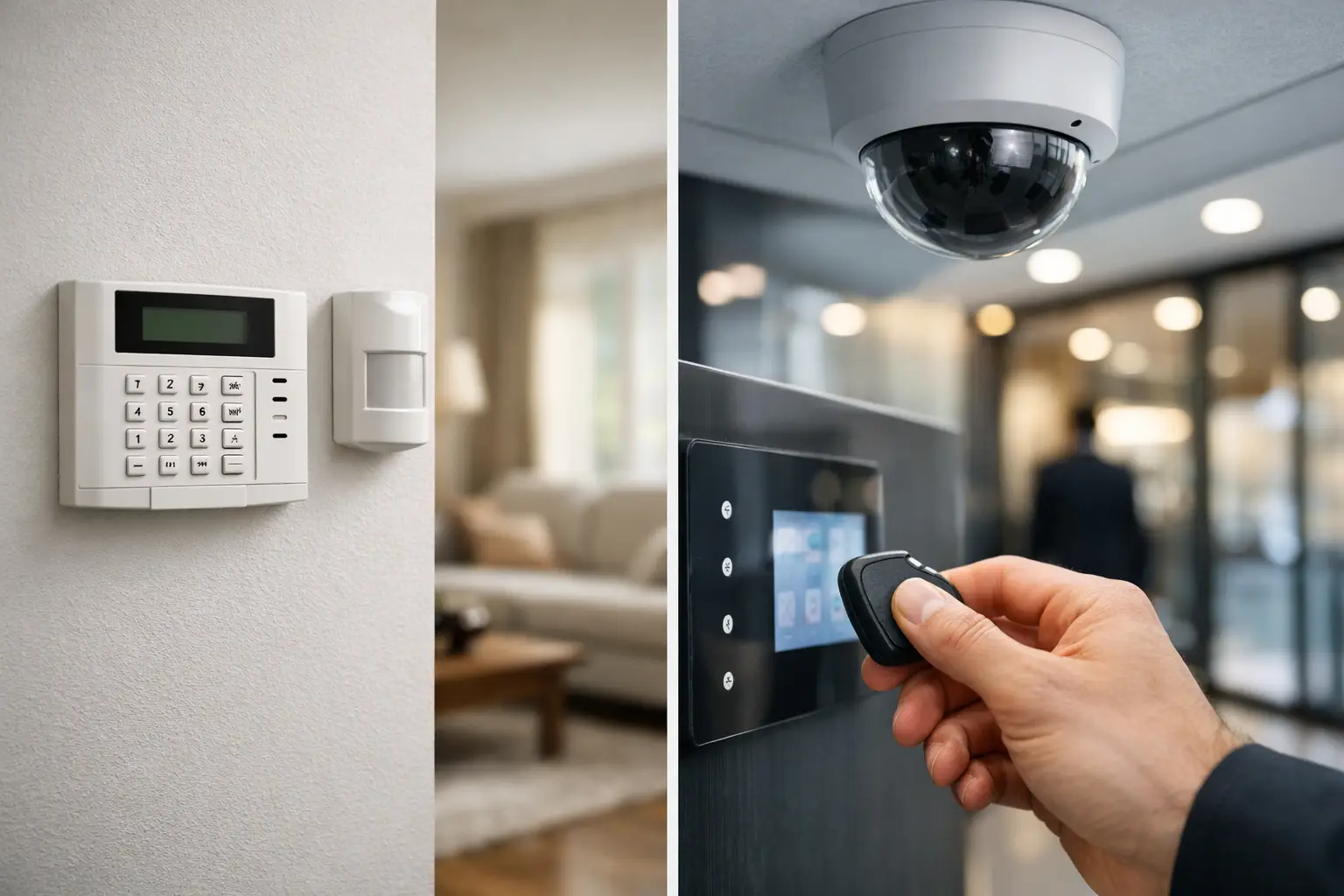
A break-in rarely follows a convenient script. It may happen through a rear door hidden from the street, a ground-floor window during school pick-up, or an unlocked storeroom after business hours. A useful alarm system comparison starts with how your property is actually used, not with the loudest siren or the lowest advertised price.
For Australian homeowners, property managers and business operators, the right system needs to be dependable when the building is empty, straightforward to use when it is occupied, and installed in a way that protects the property without creating daily frustration. The best choice may be a simple wireless alarm for a small home, a hardwired system for a renovation, or a monitored, integrated solution for a commercial site.
Alarm system comparison: start with the property
Before comparing brands, apps or packages, consider the building itself. A compact unit with one entry door has very different requirements from a family home with a detached garage, or a warehouse with several access points and staff moving through it at different times.
Start by identifying the points that matter most: external doors, accessible windows, garage entries, side gates, offices, stock rooms and plant areas. Then consider what happens on site after hours. Is the property completely vacant? Are pets indoors? Do cleaners, tenants or staff need separate access? These details affect detector placement, user codes and whether monitoring is worthwhile.
Security is strongest when it is planned as a complete property system. Alarm detection, cameras, exterior lighting and access control each do different jobs. An alarm can alert you to unauthorised entry, while cameras help verify activity and lighting can make vulnerable areas less attractive in the first place. Not every property needs every component, but considering them together avoids expensive changes later.
Wired versus wireless alarm systems
The central decision in most alarm system comparisons is whether to choose wired or wireless equipment. Neither is automatically better. The right option depends on the building, budget and expected lifespan of the system.
Wired alarms suit long-term upgrades
Wired alarms use physical cabling between the control panel and devices such as motion detectors, reed switches and keypads. They are particularly well suited to new builds, major renovations and commercial properties where cable routes can be planned before walls and ceilings are closed.
Their main advantage is stability. Devices do not rely on batteries, and a professionally installed wired system can provide reliable coverage for many years. This makes it a practical option for larger homes, offices, shops and premises with multiple detection zones.
The trade-off is installation access. Running cables through an established home can take more time and may involve additional labour, especially where there is limited roof or wall access. A professional assessment should identify realistic cable paths before a quote is accepted, so there are no surprises on installation day.
Wireless alarms suit existing homes and flexible spaces
Wireless systems communicate using secure radio signals and are generally faster to install in finished properties. They are often a strong choice for apartments, established homes, small offices and rental properties where extensive cabling is impractical.
A quality wireless system can be highly effective, but it needs proper design. Signal strength, the distance between devices, building materials and battery maintenance all matter. Large concrete structures, metal cladding and sprawling sites may need extra planning or signal repeaters.
Battery alerts are useful, but they should not replace routine maintenance. If a device reports a low battery, replace it promptly with the specified type. Wireless convenience works best when the system is checked regularly and installed with reliable coverage in mind.
Self-monitored or professionally monitored?
Modern alarms can send notifications to a mobile app, a nominated contact or a professional monitoring centre. The most suitable option comes down to how quickly someone can respond and the level of support you want outside normal hours.
With self-monitoring, the system sends an alert directly to you. This can be a cost-effective solution for homeowners who are usually nearby, can check camera footage quickly, or have trusted neighbours who can assist. It also gives you visibility over arming status, open doors and alarm events through a compatible app.
The limitation is simple: you still need to act. If you are driving, working in a meeting, travelling or asleep, an alert may not receive immediate attention. A notification also does not confirm whether the cause is a genuine intrusion, a pet, an open window or a detector fault.
Professional monitoring adds an organised response process. Depending on the service arrangement, trained operators receive alarm signals and follow agreed escalation procedures, such as contacting keyholders or emergency services when appropriate. This is often a sensible investment for businesses, high-value stock areas, vacant properties and households that travel regularly.
Monitoring has ongoing fees, so it should be weighed against the property’s risk and the consequence of a delayed response. It is worth asking exactly what the service includes, how faults are handled and who is contacted first.
Choosing the right detection devices
An alarm panel is only as useful as the devices connected to it. A well-designed system uses the right detector in the right place rather than placing motion sensors in every room.
Door and window contacts identify when a protected entry point opens. They are particularly valuable on external doors, sliding doors and accessible windows. Motion detectors cover internal movement and are commonly used in hallways, living areas, offices and stock rooms. Glass-break detection may be appropriate where large glazed areas are a concern, while outdoor beams can provide an early alert around a perimeter or driveway.
Pet-friendly motion detectors are available, but they are not a guarantee against false alarms. Detector height, pet size, furniture placement and the animal’s behaviour all need to be considered. A cat that climbs shelving or a large dog that jumps on furniture can still trigger a poorly positioned sensor.
For commercial sites, zoning deserves close attention. Separate zones can allow staff to work in one area while a warehouse, office wing or storage room remains armed. Clear zone labels also make it easier to understand an alarm event and investigate faults quickly.
Connectivity, backup power and app access
Many systems use an internet connection for app control and notifications. That is helpful, but it should not be the only communication path considered. If the NBN connection is interrupted or power is lost, the system still needs a way to report important events.
Ask whether the alarm has battery backup and whether it can communicate through a cellular connection. These features can make a meaningful difference during an outage or when an intruder damages communications equipment. For commercial premises, confirm how long backup power is expected to support the panel and communication device.
App control is convenient for checking status, arming the system remotely and receiving alerts. It is not always necessary to give every user full control, however. Use individual codes or app permissions for family members, staff, cleaners and contractors where possible. When someone no longer needs access, remove it promptly rather than relying on a shared code being kept private.
Cost: look beyond the package price
An entry-level alarm package may appear affordable, but a fair comparison needs to include the full scope. Consider the number and type of detectors, keypad locations, communications equipment, backup battery, installation labour, commissioning, app access, monitoring fees and future additions.
Cheapest is not always best, particularly when the system leaves vulnerable entries uncovered or has no practical path for expansion. At the same time, there is little value in paying for complex features that no one on site will use. A good design matches the system to genuine risks and everyday routines.
For strata managers and business operators, it is also wise to consider ongoing maintenance. Who will test the system, replace batteries, update contact details and respond to faults? Assigning responsibility early prevents a system from becoming unreliable through neglect.
Installation quality matters as much as equipment
Even reputable alarm equipment can perform poorly if devices are badly positioned, cables are unprotected or the system is not commissioned properly. Installation should include testing of each detector, confirmation of communication paths, clear user instructions and a handover that explains arming, disarming and fault messages.
A licensed security and electrical professional can also identify electrical and practical issues that product-only comparisons miss, such as suitable power supply locations, cable protection, lighting coverage and integration with existing cameras or access control. Voltricity can assess these elements together, helping property owners make decisions that suit the building now and allow for future changes.
The right alarm is the one your household or team can use confidently every day, while providing dependable protection when no one is there to watch the door.