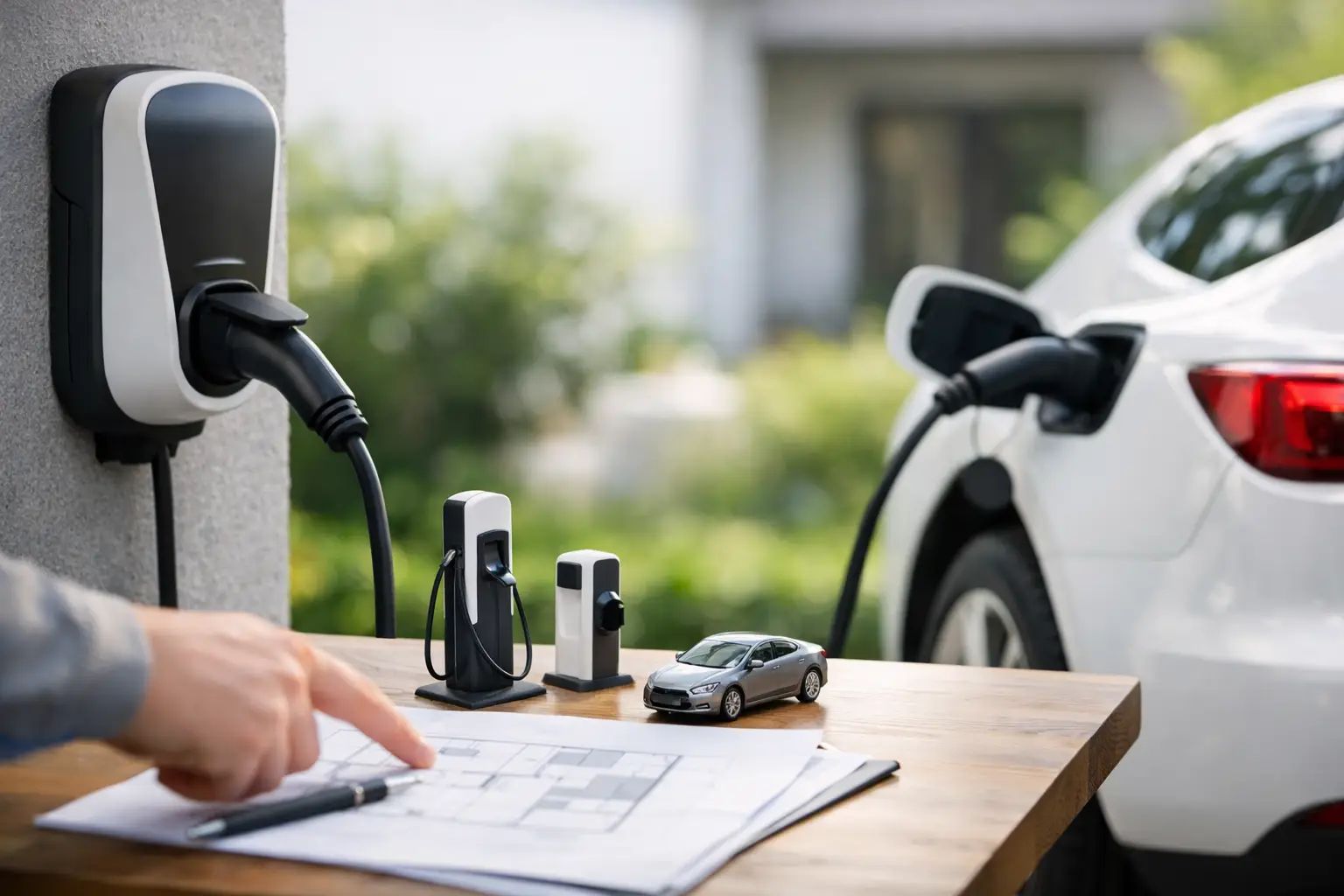
If you have already bought an electric vehicle, or you are close to ordering one, the charger decision usually arrives faster than expected. Most people start by looking at price, then realise the real question is how to choose EV charger that suits the property, the vehicle, and the way it will be used day to day.
That matters because the right charger should feel simple once it is installed. It should match your switchboard capacity, charge at a practical speed, and work safely for years without causing hassle. The wrong one can leave you paying for features you do not need, waiting longer than expected for charging, or facing upgrade costs that could have been planned earlier.
How to choose EV charger without overcomplicating it
A good place to start is not the charger brand. It is your usage. A homeowner with one EV parked in the garage overnight needs something very different from a strata property manager planning for multiple residents, or a business operator wanting staff and visitor charging during the day.
For most properties, the decision comes down to five things: how fast you need to charge, what electrical capacity the site has, whether you want smart controls, where the charger will be installed, and how future needs might change. Once those are clear, the shortlist becomes much easier.
Start with charging speed
Not every EV charger delivers the same output, and faster is not always better. Many residential installations use AC wall chargers, often in the 7kW range for single-phase homes. That is enough for a large share of households because the vehicle can charge overnight while electricity demand is lower and the car is not in use.
Some homes and commercial sites may be suited to three-phase charging, which can support higher charging speeds if the vehicle and site both allow it. But there is no point paying for extra charging capacity if your car cannot accept it, or if your daily driving only uses a modest amount of battery.
A practical question helps here: how many kilometres do you typically need to replace between charges? If the vehicle is mostly used for commuting, school runs, and local trips, standard home charging may be more than enough. If it is a fleet vehicle, a high-use company car, or part of a business operation where downtime matters, faster charging may be worth it.
Check your power supply before choosing the unit
This is where many charger comparisons go off track. The charger you want still has to suit the electrical infrastructure you have. Your property may be single-phase or three-phase, and the available capacity on the switchboard will influence what can be installed safely.
In some cases, the charger installation is straightforward. In others, the site may need a switchboard upgrade, dedicated circuit, load management setup, or other electrical work before the charger can be connected properly. That is especially common in older homes, renovated properties with added electrical demand, and commercial sites with multiple large appliances or equipment loads.
This is one of the biggest trade-offs in how to choose EV charger. A cheaper unit is not necessarily the cheaper project if it triggers avoidable compatibility issues. A licensed electrician can assess the site first and tell you whether the existing setup supports the charger you are considering.
Choose features that match how you will actually use it
Once speed and power supply are sorted, features become the next decision point. Some people want a simple plug-in-and-charge unit. Others want app controls, scheduling, usage reports, solar integration, RFID access, or the ability to balance loads across multiple chargers.
At home, scheduling can be useful if you want to charge during off-peak periods or coordinate charging with rooftop solar production. For investment properties or shared-use sites, access control matters more because you may need to limit who can use the charger. For businesses, reporting and user management can become important if you want to track electricity use, assign charging to staff vehicles, or prepare for multiple users over time.
The key is to avoid paying for complexity you will never use. Smart features are valuable when they solve a real operational problem. They are less valuable when they just add cost and another app to manage.
Tethered or untethered?
This detail gets overlooked, but it affects convenience. A tethered charger has a cable attached, which is often easier for daily home use because the cable is always there and ready. An untethered charger uses a separate cable, which can look neater and offer more flexibility across different vehicle connections.
There is no universal best option. Tethered units tend to suit homeowners who want speed and simplicity. Untethered units can work well where appearance, shared use, or connector flexibility matters more.
Indoor, outdoor, residential, or commercial
The installation environment matters as much as the charger itself. A charger mounted inside a private garage has different exposure and security needs from one installed on an external wall, open car park, basement, warehouse, or visitor parking area.
Outdoor installations should be selected and positioned with weather exposure, cable management, impact risk, and user access in mind. Commercial settings may also need bollards, signage, access controls, or dedicated protection measures. A charger that looks fine on paper may not be the best fit for the actual site conditions.
Think beyond today’s vehicle
A lot of people choose a charger based only on the EV they own right now. That can be perfectly reasonable, but it is worth thinking one step ahead. Will there be a second EV at home within a few years? Is the business likely to add electric fleet vehicles? Could tenant or staff demand for charging increase?
Futureproofing does not always mean buying the highest-spec charger available. Sometimes it means choosing a model with smart load management, selecting a location that allows a second charger later, or planning switchboard capacity early so the next stage is easier and less expensive.
This is especially relevant for commercial properties and multi-vehicle households. The right choice today should not create unnecessary limits tomorrow.
Safety, compliance, and installation quality
An EV charger is not just another appliance. It is a high-load electrical installation that needs to be selected and installed correctly. Safety, compliance, circuit protection, and workmanship all matter.
That is why brand claims and online reviews should never replace a proper site assessment. A charger may be popular, but if it is not suitable for your supply, location, or intended use, it is still the wrong product. Installation quality also affects reliability. Poor cable routing, incorrect protection, weak mounting, or inadequate testing can create problems that show up later.
For homeowners and business operators, the safest path is straightforward: choose a licensed electrician with experience in EV charger installation, ask what site upgrades may be required, and get clear advice on the full scope of works before installation begins. Transparent pricing and a warranty-backed install matter just as much as the unit itself.
Price matters, but total value matters more
Everyone wants a fair price, and that is sensible. But when comparing chargers, it helps to separate the unit cost from the installation cost and from the long-term value of the setup.
A lower-cost charger may be perfectly suitable if your needs are simple. On the other hand, a slightly higher upfront spend can make more sense if it gives you better compatibility, smarter energy management, stronger durability, or room to expand later. For commercial sites, reliability alone can justify the difference, because downtime and user frustration carry their own cost.
The same goes for electrical upgrades. If your switchboard or existing wiring needs attention, that work is not an optional add-on. It is part of making the charger safe and dependable.
The best choice is the one that fits the property
When people ask how to choose EV charger, they are often expecting a single best model or size. In reality, the better question is which charger suits the vehicle, the site, and the way the property operates.
A compact home charger may be ideal for one family and completely unsuitable for a business with regular daily vehicle turnover. A smart commercial unit may be excellent technology and still be unnecessary for a homeowner who just wants reliable overnight charging. Good advice comes from matching the charger to the property, not from forcing the property to fit the charger.
If you are unsure where to start, begin with a site-based conversation rather than a product-based one. That approach usually saves time, avoids surprises, and leads to a charger that works properly from day one. And once it is in place, that is exactly how it should feel – simple, safe, and ready when you need it.