A camera that drops out during a storm, misses a delivery at the front door, or records patchy footage when you need clear evidence is not much use. When clients ask about hardwired vs wireless CCTV, they are usually not chasing features for the sake of it. They want a system that works properly, suits the property, and does not create headaches later.
The right choice depends on how your home or business is built, how much coverage you need, and how important reliability is in day-to-day use. Both options can do the job well, but they solve different problems.
Hardwired vs wireless CCTV – what is the real difference?
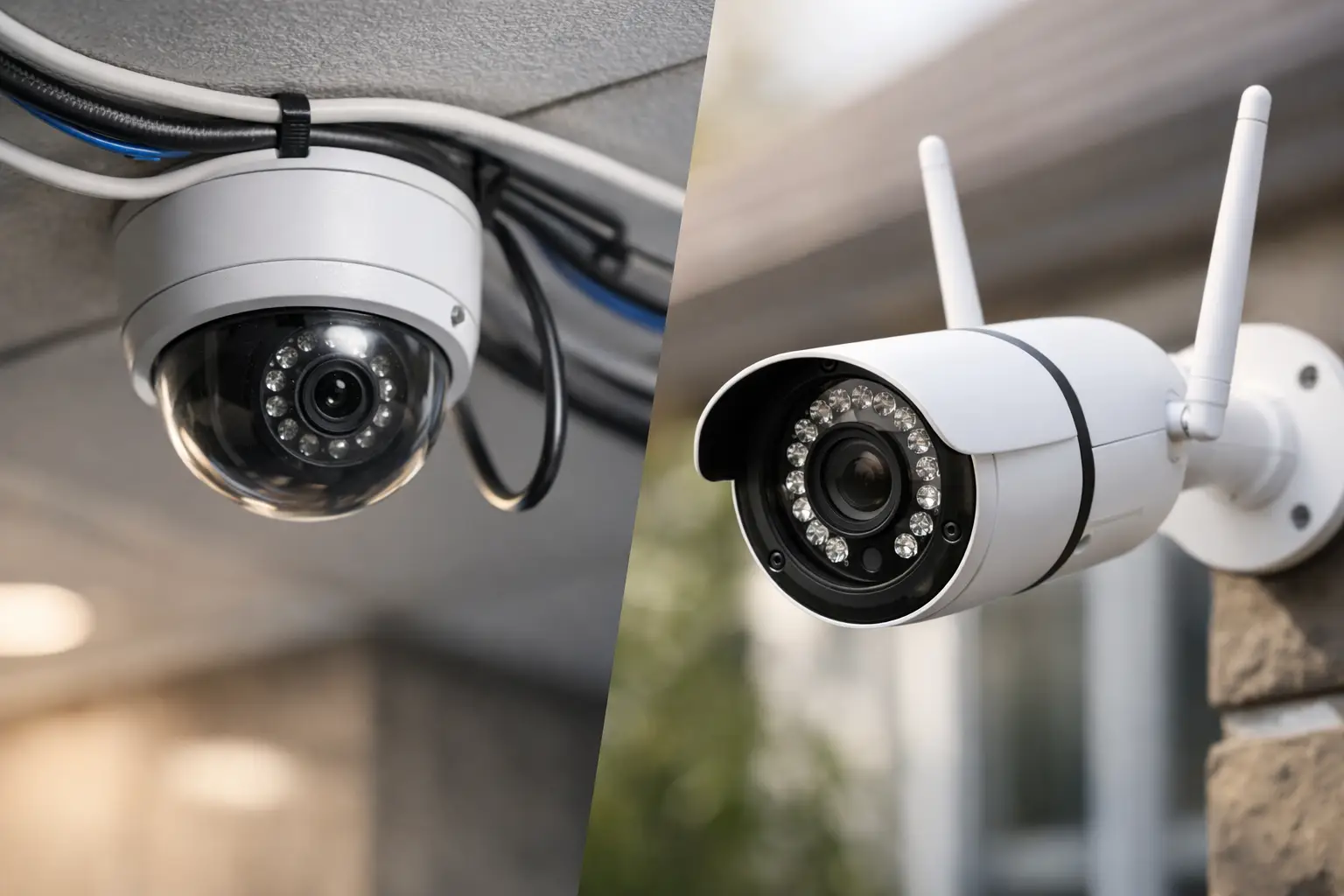
A hardwired CCTV system uses physical cabling to connect cameras back to a recorder or network point. In most cases, that means more installation work upfront, but also a more stable and permanent setup. Power and data are usually handled in a planned, integrated way.
A wireless CCTV system sends video over Wi-Fi rather than through a dedicated data cable. Some wireless cameras still need power from a nearby powerpoint, while others run on rechargeable batteries. That makes them quicker to install in certain locations, especially where running cable is difficult or where a temporary solution is needed.
The term wireless can be a bit misleading. Many people assume it means no wiring at all, but most systems still need some form of power unless they are battery-operated. That matters because convenience at installation does not always translate to convenience over the long term.
Reliability matters more than most people expect
For most properties, reliability is where the difference becomes clear. Hardwired systems generally offer more consistent performance because they are not competing with your home or office Wi-Fi. They are less likely to suffer from signal dropouts, interference, or lag during busy network periods.
That makes a real difference on larger blocks, double-storey homes, warehouses, retail sites, and offices with multiple users connected to the same network. If you are relying on cameras for after-hours monitoring, vehicle access, stock protection, or incident review, stable footage is not optional.
Wireless CCTV can still perform well in the right environment. In a smaller home with strong Wi-Fi coverage and only a handful of cameras, it can be a practical solution. But if the modem is too far away, walls are thick, or the network is already under pressure, performance can become inconsistent. A camera that works perfectly in a brochure may struggle at the back fence or in a detached garage.
Installation cost versus long-term value
Wireless systems often look cheaper at first glance. The equipment may be more affordable, and installation can be faster because there is less cabling involved. That appeals to homeowners who want a straightforward setup or business operators trying to secure a small tenancy without major works.
Hardwired systems usually cost more upfront because the installation is more involved. Cables need to be run neatly and safely, camera positions need proper planning, and the whole setup has to be integrated correctly. But that higher initial investment can deliver better value over time, particularly when you want dependable coverage and fewer ongoing issues.
There is also the question of maintenance. Battery-powered wireless cameras need charging or battery replacement. Wi-Fi connected cameras may need repositioning, network troubleshooting, or occasional reconfiguration if your internet setup changes. Hardwired systems tend to be lower maintenance once installed properly.
Image quality and recording performance
Clear footage matters most when something goes wrong. You do not want to find out too late that faces are blurred, number plates are unreadable, or the recording skipped the important moment.
Hardwired CCTV usually has the edge here because it can handle higher data loads more consistently. That supports better image quality, more reliable continuous recording, and smoother playback. For commercial sites, shared driveways, entrances, loading areas, and cash handling zones, that extra consistency can be worth it.
Wireless CCTV can still deliver sharp images, especially with modern cameras, but quality often depends on signal strength and available bandwidth. If the network is unstable, footage may compress more heavily, lag, or fail to upload as expected. Cloud-based recording can also be affected by internet outages or speed limitations.
That does not mean wireless is poor quality. It just means performance depends more heavily on the surrounding setup.
Which system suits homes best?
In residential settings, the best option usually comes down to layout, access, and future plans. A smaller home, townhouse, or unit can be well suited to wireless CCTV if the Wi-Fi signal is strong and the owner wants a less invasive installation. It can also be useful for renters or for properties where drilling and cabling need to be kept to a minimum.
For larger homes, renovated properties, and houses with multiple entry points, hardwired CCTV often makes more sense. If you want cameras at the front door, side access, backyard, garage, and driveway, a wired setup generally gives more dependable coverage. It is also the better fit when you want the system integrated with other electrical or security works.
There is another practical factor here. Many homeowners start with two cameras and later decide they want four or six. Hardwired systems are often easier to scale properly when expansion is part of the plan from the beginning.
Which system suits businesses best?
For most commercial environments, hardwired CCTV is usually the stronger choice. Businesses often need continuous recording, broader coverage, and dependable performance across longer operating hours. They may also need to monitor multiple zones at once, retain footage for compliance reasons, or review incidents in detail.
Retail shops, offices, workshops, childcare centres, medical premises, warehouses, and strata-managed sites all benefit from stability and consistent recording. In these situations, wireless CCTV can work for a small site or a quick deployment, but it is rarely the first recommendation for a larger or more security-sensitive environment.
Business owners also need to think about risk. If a camera goes offline during a network issue, who notices? If battery maintenance is missed, what area is left uncovered? A hardwired system reduces those variables and gives more confidence that the system will be operating when it is needed.
Hardwired vs wireless CCTV for difficult properties
Some properties do not fit neatly into one category. Older buildings, finished interiors, heritage elements, detached sheds, and complex layouts can all affect what is practical.
This is where a site-specific approach matters. Sometimes a fully hardwired setup is clearly the best fit. Sometimes a hybrid approach works better, with wired cameras covering the critical areas and wireless units used where cabling would be disruptive or uneconomical. The best result is not always the one with the most features. It is the one that gives reliable coverage without unnecessary complications.
A good installer looks beyond the camera itself. They assess power access, cable routes, network strength, recording needs, blind spots, and how the system will be used in real life.
Questions worth asking before you choose
Before deciding, think about what you actually need the CCTV system to do. Are you mainly checking parcel deliveries and front door activity, or do you need complete perimeter coverage and reliable evidence retention? Do you want a quick install for a single access point, or a long-term security upgrade that becomes part of the property infrastructure?
It also helps to ask how often you are willing to maintain the system. If you want a set-and-forget solution, hardwired is often the safer bet. If flexibility and speed matter more than total permanence, wireless may be perfectly suitable.
At Voltricity, these are the kinds of questions that shape the recommendation. The goal is not to push one system over the other. It is to match the installation to the property, the risk level, and the way the client actually uses the space.
The better option is the one that suits the job
If you want the short answer, hardwired CCTV is usually better for reliability, scale, and long-term performance, while wireless CCTV is often better for fast installation, flexibility, and smaller properties with strong network coverage.
That said, the better system is not the one with the bigger spec sheet. It is the one that gives you clear footage, dependable operation, and confidence that your home or business is properly covered. If you choose with the property in mind rather than the packaging, you will usually get a far better result.