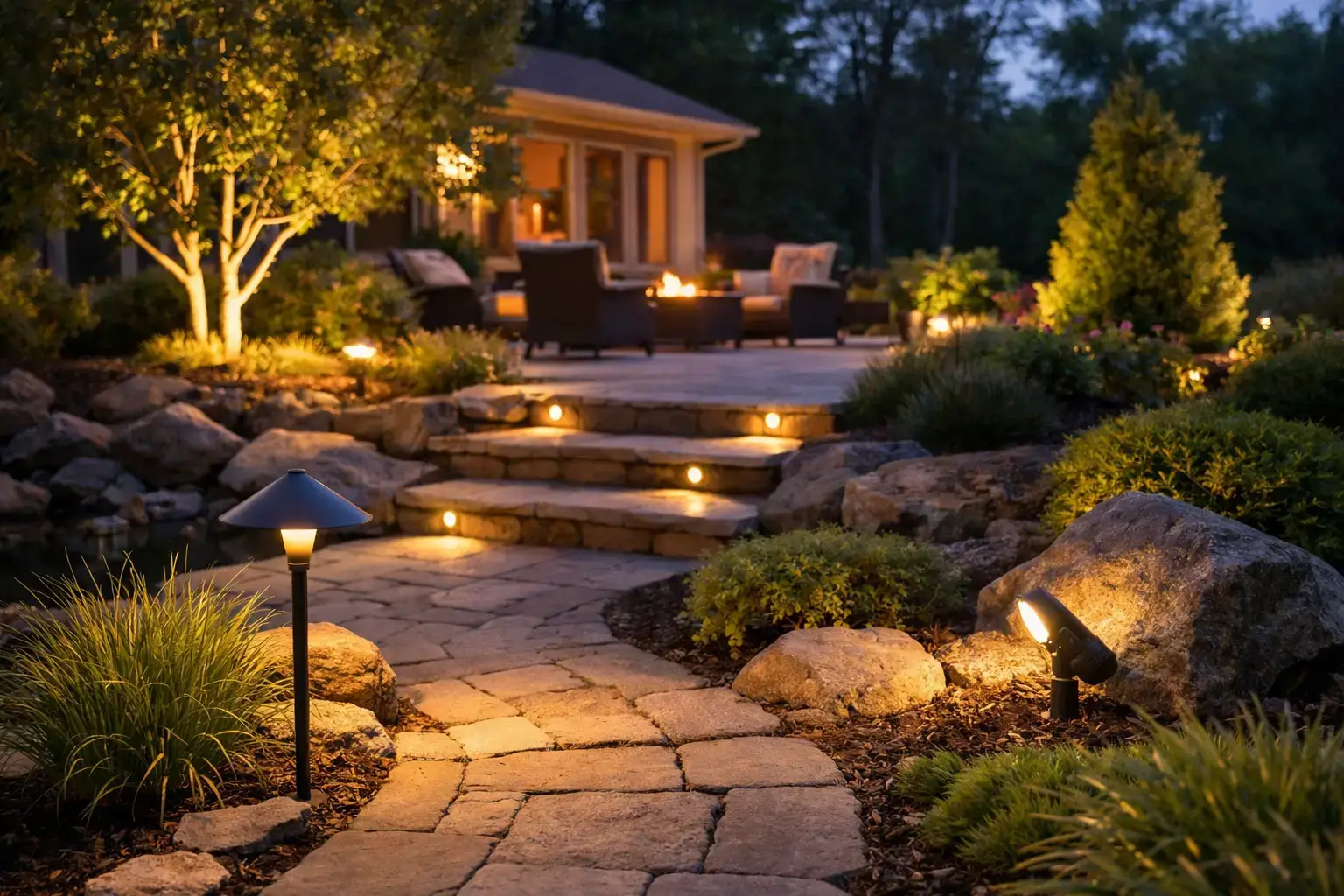
A dark front path, an unlit driveway or a backyard that disappears after sunset can make a property feel incomplete. Well-planned outdoor landscape lighting systems fix that quickly, but the real value is not just how they look – it is how they improve safety, visibility and the way you use the space every night.
For homeowners, that might mean safer entry points, better visibility around steps and a garden that still feels welcoming after dusk. For property managers and business operators, it can mean clearer access routes, better after-hours presentation and fewer shadowed areas around the building. Good lighting changes how a property functions, not just how it photographs.
What outdoor landscape lighting systems should actually do
The best lighting layouts are practical first and decorative second. That does not mean they need to look plain. It means every fitting should have a purpose, whether that is guiding people to the front door, lighting a retaining wall, highlighting architectural features or improving visibility around gates and side access.
A common mistake is treating outdoor lighting like a shopping list – a few path lights here, a floodlight there, maybe some spike lights in the garden bed. The result is often patchy, too bright in one area and too dim in another. A proper system is planned as a whole, with beam spread, fitting position, cable runs, switching and power load all considered together.
That is where electrical experience matters. Outdoor environments are hard on fittings and wiring. Moisture, heat, dust, garden maintenance and general wear all affect performance over time. If the system is not designed and installed correctly, the problems usually show up later as failed fittings, nuisance tripping, poor coverage or expensive rework.
Safety, security and street appeal need balance
People often start with one goal. They want the home to look better from the street, they want more security around the perimeter, or they want the backyard to feel usable at night. In practice, the strongest results come from balancing all three.
For safety, lighting should reduce hazards without creating glare. Steps, level changes, pool surrounds, driveways and side paths need even visibility. Harsh lighting can be just as unhelpful as poor lighting if it throws strong shadows or makes it harder for your eyes to adjust.
For security, strategic placement matters more than sheer brightness. Entry points, garages, side passages and rear boundaries benefit from lighting that removes dark pockets and supports visibility for cameras or casual observation. A single oversized floodlight can leave surrounding areas darker by contrast, while layered lighting usually produces a more reliable outcome.
For appearance, restraint usually works better than over-lighting. A few carefully chosen focal points can make a home or commercial frontage look cleaner, more premium and more inviting. The aim is to shape the space, not light every square metre equally.
The main types of outdoor landscape lighting systems
Most systems combine several fitting types because each one solves a different problem. Path lights are useful for walkways and garden edges, but they should not be expected to light wide spaces. Spike lights and uplights are ideal for trees, feature walls and planting, especially when you want depth and contrast rather than flat illumination.
Step lights and recessed fittings suit stairs, deck edges and retaining walls where discreet guidance is the priority. Wall lights work well near entries, courtyards and alfresco areas, while spotlights and floodlights are better for driveways, service areas and broader security coverage.
Then there is control. Some clients prefer simple switching. Others want timers, sensors or smart controls that adjust operation based on routine or occupancy. The right answer depends on how the property is used. A family home may need flexibility across entertaining areas and access paths, while a commercial site may prioritise consistency, energy efficiency and after-hours security.
Why low-voltage is popular – and where mains still matters
Low-voltage landscape lighting is popular for good reason. It can be efficient, flexible and well suited to gardens, paths and feature lighting. It is often the right choice where multiple small fittings are spread across an outdoor area and visual subtlety matters.
That said, low-voltage is not automatically the better option in every project. Larger properties, higher output requirements and certain commercial applications may still call for mains-powered fittings in parts of the system. The best choice depends on cable distances, desired light levels, fitting locations and how the installation will be maintained over time.
This is where a site-based assessment is worth it. What works beautifully in a compact front garden may not perform well across a long driveway, a large yard or a mixed-use property with several access zones.
Design decisions that make the biggest difference
Brightness is only one part of the job. Colour temperature, beam angle, spacing and mounting height all change the final effect. Warm white lighting often feels more welcoming around homes and hospitality spaces, while cooler temperatures may suit some security-focused or commercial areas. Neither is universally right.
Beam control is another detail people tend to notice only when it goes wrong. A narrow beam can create a sharp, dramatic feature on a tree or column, while a wide beam helps spread light more gently across paths or walls. If fittings are too close together, the result can feel cluttered. Too far apart, and the space develops dark gaps that make the whole system look unfinished.
There is also the issue of glare. Outdoor lighting should help people see the space, not force them to squint across it. Shielding, aiming and fitting selection all matter. The nicest lighting schemes are often the ones you barely notice directly because the effect feels natural.
Installation quality is where long-term value comes from
A good-looking plan can still fail if the installation is rushed. Outdoor electrical work needs careful cable routing, correct connections, suitable weather protection and proper integration with the existing electrical system. If a property already has older wiring, overloaded circuits or limited switching options, those issues should be addressed before new lighting is added.
This is especially important in homes and commercial sites where lighting upgrades sit alongside other electrical needs. It often makes sense to review switchboard capacity, outdoor power access, sensor placement and even future additions such as security cameras, gates or EV charging. Planning these together avoids duplicated labour and helps the overall system make sense.
Voltricity approaches this kind of work as part of the broader electrical picture, which is often what clients need most – one reliable provider who can install lighting properly while keeping safety, compliance and future expansion in view.
Maintenance matters more than most people expect
Outdoor fittings live a tougher life than indoor ones. Dirt builds up, plants grow into beam paths, seals age, and accidental damage happens during gardening or general property maintenance. Even high-quality systems need periodic checks to keep performing properly.
The good news is that a well-installed system is much easier to maintain. Logical circuit layout, accessible drivers or transformers, durable fittings and clear control settings all save time later. If replacement is needed, standardised fitting types and a sensible design make upgrades simpler rather than turning every repair into detective work.
For property managers, this has a direct cost impact. For homeowners, it affects whether the system continues to add value or slowly becomes another half-working feature around the house.
When it is worth upgrading an older setup
If the current outdoor lighting is inconsistent, unreliable or expensive to run, an upgrade is often worth considering. Older systems can suffer from poor energy performance, dated fitting styles, water ingress issues and limited control options. Even if some parts still work, the overall result may be underwhelming compared with a modern, well-planned layout.
Upgrading does not always mean starting from scratch. In some cases, existing cabling routes or fixture locations can be reused. In others, a full redesign is the smarter option, especially if the garden has changed, new structures have been added or the property now has different security and access needs.
What matters is getting honest advice on what is still serviceable and what is likely to cause trouble later. That kind of clarity saves money and avoids the cycle of patch repairs that never quite solve the problem.
Choosing a system that suits the property
The right outdoor landscape lighting systems are the ones that match the way the property is used every day. A family home needs safe access, comfort and a welcoming look. A commercial site may need clearer circulation, more reliable perimeter lighting and stronger support for security. A managed property usually needs durability, ease of maintenance and predictable operating costs.
That is why there is no single perfect layout, fitting or control method. The best outcome comes from looking at the site properly, identifying what the lighting needs to achieve and installing a system that will still perform well after the novelty wears off.
If you are planning new outdoor lighting, think beyond the fittings themselves. The real result comes from good design, licensed installation and a system built to handle real conditions. Done properly, outdoor lighting does more than brighten the yard – it makes the whole property feel safer, more functional and more complete after dark.