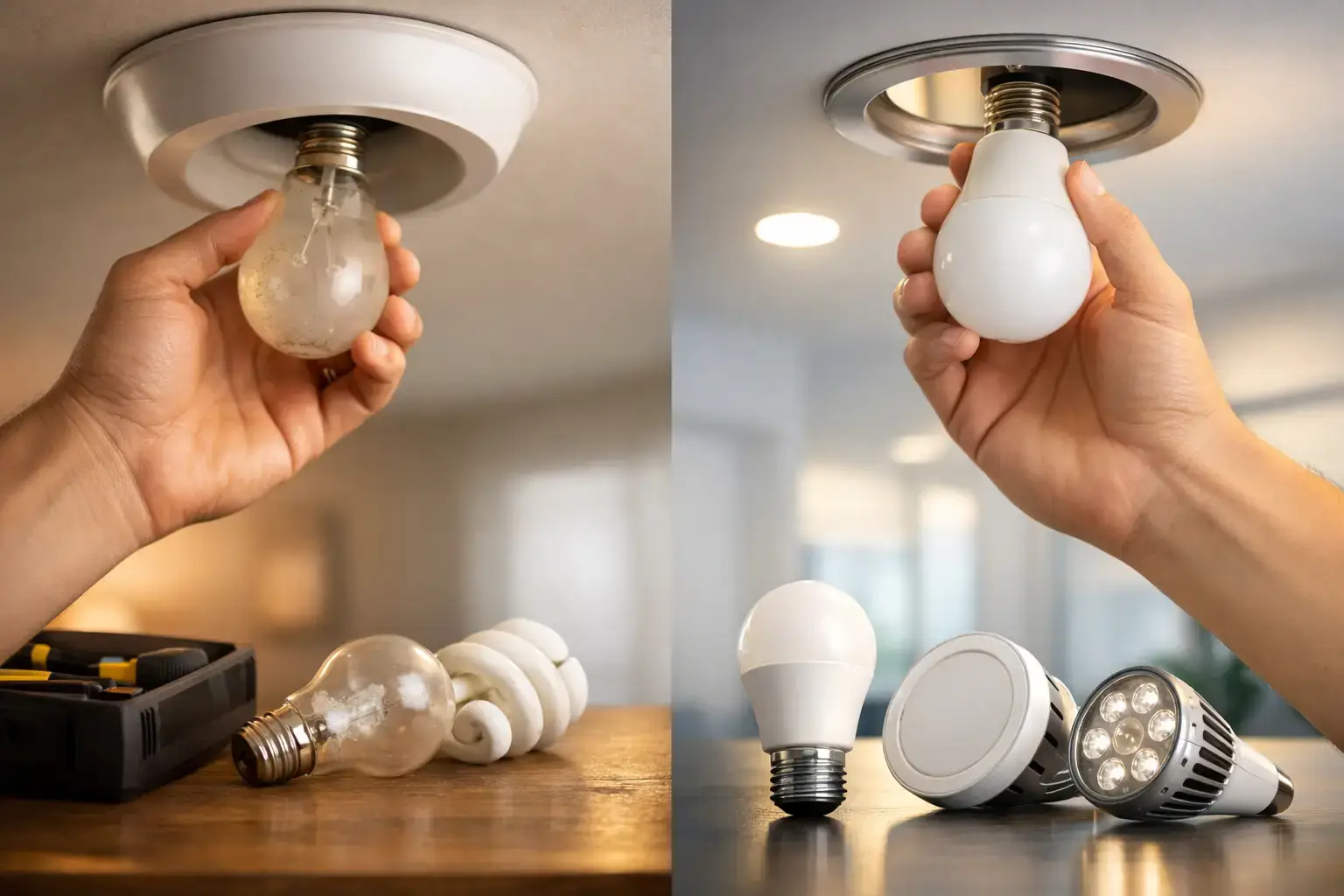
A flickering downlight in the kitchen, a yellowed oyster light in the hallway, or an office fit-out that still feels dim at 3 pm – most people start with the same question: should you just change lights, or is it time for something more substantial?
The answer depends on what is actually causing the problem. Sometimes it is as simple as replacing a failed globe. Other times, the fitting is outdated, the circuit is overloaded, or the lighting layout no longer suits how the space is used. If you get that call wrong, you can spend money on quick fixes that do not last.
Change lights or replace the whole fitting?
This is where many homeowners and property managers get caught out. Not every lighting issue is solved by changing a bulb, and not every old fitting needs a full replacement either.
If the light fitting is modern, in good condition, and designed for replaceable globes, a straightforward change may be all that is needed. That is often the case with table lamps, some pendants, and selected outdoor fittings. But with many LED downlights and integrated fixtures, the light source is built into the fitting. Once it starts failing, you are not really there to change lights in the traditional sense – you are replacing the unit.
There is also the age factor. Older fittings can look fine from the outside while the internal wiring, connections, or lampholders are deteriorating. Heat, dust, moisture, and years of use all take a toll. In those cases, replacing the globe might get the light back on briefly, but it does not deal with the real issue.
For commercial spaces, the decision usually comes down to efficiency and presentation as much as function. If staff are working under patchy, uneven light or customers are walking into a dim reception area, keeping outdated fittings alive can cost more in the long run than upgrading to something better suited to the space.
Signs it is time to change lights
There are a few clear situations where changing lights makes sense, provided the fitting itself is safe and compatible.
A globe that has simply reached the end of its life is the obvious one. If there is no flickering before failure, no tripping circuit, and no visible damage to the fitting, a replacement may be all that is required. The same applies if the current globe type is working but the room feels too dark or too harsh. Swapping from an old halogen or CFL to a suitable LED option can improve brightness, reduce power use, and cut down maintenance.
This is also common during renovations or property updates. Owners often want to change lights to improve the feel of a room without moving wiring or opening up ceilings. A warmer colour temperature in living areas, brighter task lighting in kitchens, or cleaner exterior lighting around entry points can make a property feel more modern without turning the job into a full electrical rework.
That said, compatibility matters. Not every LED works properly with every dimmer, transformer, or fitting. If the wrong parts are mixed together, you can end up with buzzing, flashing, shortened lifespan, or poor performance from day one.
When changing lights is not enough
If the same fitting keeps blowing globes, that is a warning sign. So is flickering that continues after a replacement, lights that take time to come on, switches that feel hot, or any burning smell around the fitting. Those are not cosmetic problems. They can point to loose connections, failing components, overloaded circuits, or damage hidden in the ceiling space.
You should also be cautious with older homes and commercial premises that have had multiple alterations over time. It is not unusual to find mismatched fittings, ageing cabling, or lighting that was installed to older standards. What looks like a small replacement job on the surface can expose bigger issues once inspected properly.
Bathrooms, laundries, car parks, workshops, and outdoor areas bring another layer of risk because moisture and environmental exposure affect both safety and product choice. In those spaces, the right IP rating, installation method, and circuit protection matter just as much as the fitting itself.
If you are changing several lights at once, that is often the right time to step back and assess the whole setup. A piecemeal approach can work, but it can also leave you with inconsistent brightness, mixed colour temperatures, and fittings that age at different rates.
The practical difference a lighting upgrade makes
A proper lighting upgrade is not only about making a place look newer. It changes how a space works.
In homes, the biggest gains are usually comfort, visibility, and energy efficiency. Better lighting in kitchens and bathrooms improves day-to-day use. Updated exterior lighting can make access safer at night and improve security around driveways, entry points, and side paths. In living areas, the right combination of ambient and task lighting makes the home feel more comfortable without relying on overly bright single fittings.
For businesses, lighting affects staff performance, customer experience, and maintenance costs. Harsh or uneven lighting can make a workplace fatiguing. Poorly lit stockrooms, stairwells, and access areas can also create avoidable safety risks. Newer LED systems usually offer longer life, lower running costs, and better consistency across the site.
This is where a licensed electrician adds real value. The job is not just to install a new fitting. It is to assess the load, confirm compliance, check the condition of existing wiring, and make sure the final result works properly in the real world.
Choosing the right lights for the space
The best replacement is not always the brightest one. Light output, beam angle, colour temperature, dimming compatibility, fitting size, and intended use all matter.
Warm white generally suits bedrooms, lounges, and hospitality-style spaces where comfort matters. Neutral white often works well in kitchens, bathrooms, offices, and retail settings because it gives a cleaner look without feeling too cold. Cooler temperatures can suit task-heavy commercial environments, but they are not always the right choice for customer-facing or residential areas.
Then there is placement. A single central fitting may technically light a room, but it often leaves shadows exactly where people need visibility most. That is why downlights, feature lighting, under-cabinet lighting, sensor lights, and outdoor security lighting are usually planned together rather than chosen one by one.
Property managers also need to think beyond the immediate install cost. Standardised fittings across multiple tenancies or common areas can simplify future maintenance. In strata and commercial sites, that kind of forward planning saves time and avoids repeated call-outs for mismatched replacements.
Safety comes first when you change lights
There is a difference between replacing a standard globe and carrying out electrical work on a fitting or circuit. Once wiring, fittings, switches, or hardwired components are involved, it is licensed work.
That matters because poor installation does not just lead to nuisance faults. It can create fire risk, electric shock risk, and compliance issues – especially in rental properties, workplaces, and shared buildings. Insurance complications can follow if unlicensed work causes damage.
A professional approach also means checking the surrounding system, not only the failed light. If a fitting has been overheating, there may be insulation clearance issues. If lights dim when other appliances start, the problem could be elsewhere on the circuit. If outdoor lights keep failing, water ingress or incorrect product selection may be the cause.
For customers, the real benefit is certainty. You want to know the lights are safe, correctly installed, and set up to last.
Why timing matters
Many people wait until a light stops working completely before acting. Sometimes that is fine. Often, though, the earlier signs were there – occasional flickering, reduced brightness, intermittent switching, or a fitting that had clearly aged beyond its best.
Dealing with it early usually gives you more options. You can plan the right replacement, coordinate multiple jobs in one visit, and avoid the inconvenience of sudden failures. For businesses, that can mean less disruption to staff and customers. For homeowners, it means getting the job sorted before it turns into an urgent repair.
Whether you need to change lights in one room or rethink lighting across an entire property, the smartest move is to treat lighting as part of the bigger electrical picture. A well-lit space should not only look better. It should be safer, more efficient, and better suited to the way you actually use it.
If you are unsure whether a light needs a simple replacement or a proper upgrade, a licensed electrician can help you make the call with confidence – and that is usually the difference between a quick patch-up and a result that lasts.