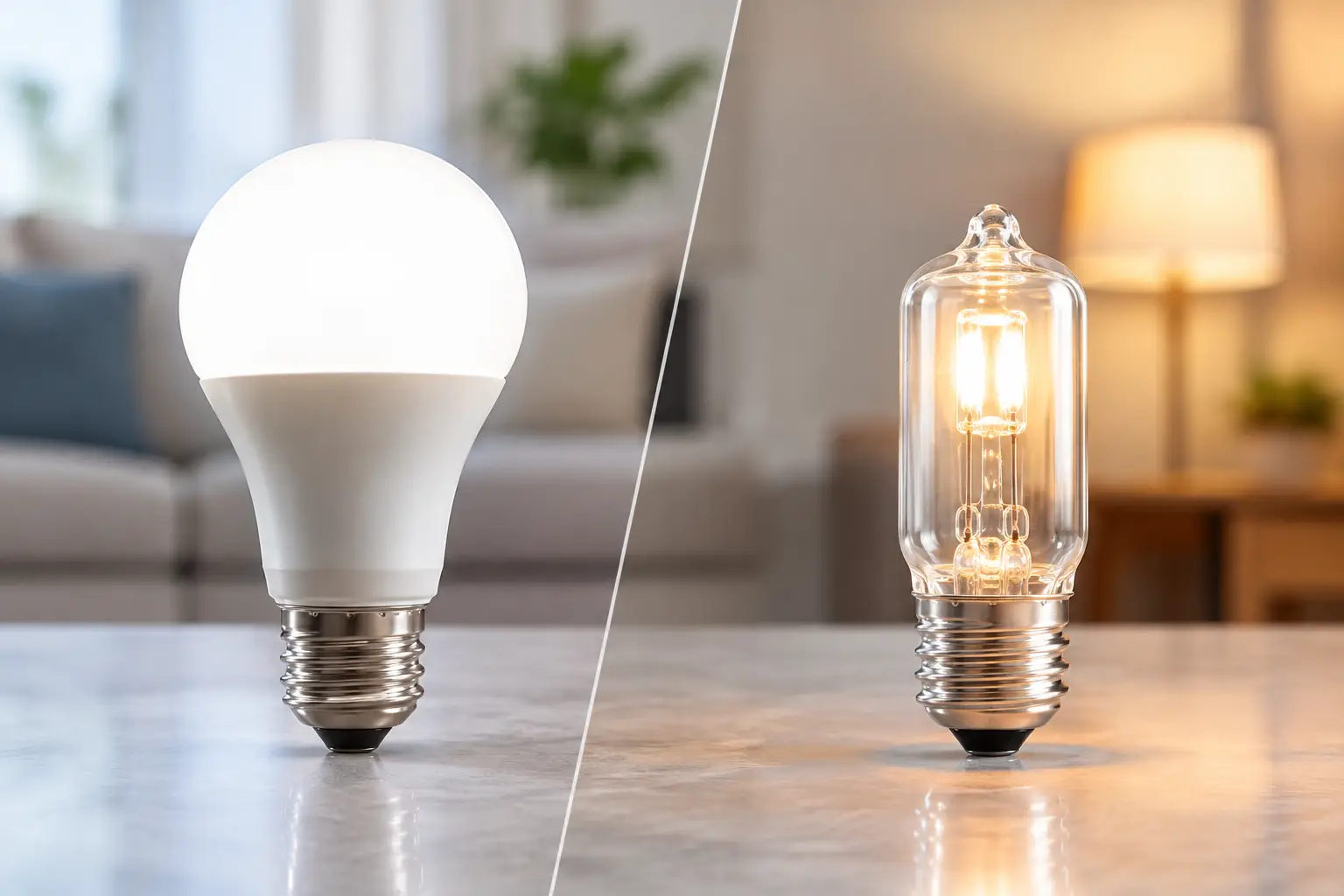
A failed halogen globe can feel like a small nuisance. But when several fittings run hot, need frequent replacement or add noticeably to power costs, the choice between LED lighting vs halogen becomes a practical property decision. For homes, offices, shops and strata-managed spaces, LED upgrades can improve efficiency and reduce maintenance, provided the fittings, controls and installation are properly assessed.
LED lighting vs halogen: the main difference
Halogen lighting is an improved form of incandescent lighting. It produces light by heating a filament inside a small glass capsule. That process creates a bright, familiar light, but a significant portion of the energy used becomes heat rather than useful illumination.
LEDs, or light-emitting diodes, create light electronically. They use far less power for a comparable level of brightness and generate much less heat at the front of the fitting. This difference affects more than electricity use. It can influence air-conditioning demand, maintenance schedules, safety around heat-sensitive materials and the long-term cost of operating a property.
For most general lighting applications, LED is now the sensible default. Halogen can still have a place in certain specialised fittings or where a compatible replacement has not yet been selected, but it is rarely the best choice for a new installation or a broad lighting upgrade.
Energy use and running costs
The clearest advantage of LED lighting is efficiency. A typical halogen downlight may use 35 to 50 watts, while an LED fitting that delivers similar usable light may use roughly 5 to 10 watts. Exact performance varies by product, beam angle and light output, but the reduction is substantial.
This matters most where lights operate for long periods. Think kitchens, living areas, retail floors, common corridors, reception areas, car parks and outdoor security lighting. Replacing one globe may make a modest difference. Replacing dozens of regularly used halogen fittings can make a meaningful impact on a household or business electricity bill.
LEDs also place less heat into a room. In air-conditioned commercial spaces, this can reduce the cooling load created by lighting. The saving will depend on the building, operating hours and HVAC system, but it is another reason LEDs are well suited to offices, retail sites and hospitality venues.
Lifespan and maintenance requirements
Halogen globes generally have a much shorter operating life than quality LED products. A halogen globe may last around 2,000 hours, while many LEDs are rated for tens of thousands of hours. Ratings are not a guarantee that an LED will run untouched for decades, but a well-selected product installed correctly should need far less frequent attention.
For homeowners, fewer globe changes are simply more convenient. For property managers and business operators, reduced maintenance can be the larger benefit. Changing lamps above stairwells, shopfronts, high ceilings or external areas takes time, may require access equipment and can disrupt tenants, staff or customers.
Not every LED product performs equally. Cheap fittings can suffer from poor heat management, inconsistent colour, driver failures or early output loss. Quality components, appropriate installation and a clear warranty matter, particularly in hard-to-reach or high-use locations.
Light quality: LEDs are not all the same
Some people prefer halogen because of its warm colour and strong colour rendering. That reputation was well earned. Halogen light is naturally warm and makes many finishes, food displays and skin tones look appealing.
Modern LEDs can now provide excellent colour quality, but the specification needs to suit the space. Warm white is often preferred in bedrooms, living rooms and hospitality settings. Neutral white can work well in kitchens, bathrooms and workplaces where visibility is important. Cool white may be suitable for task-focused commercial or outdoor applications, although it can feel harsh in a home if overused.
Colour temperature is only one part of the decision. Beam angle affects whether a downlight creates a focused pool of light or broader coverage. Colour rendering affects how accurately colours appear. Glare control, dimming performance and the placement of fittings all affect comfort. A lighting upgrade should not be treated as a simple globe swap if the goal is a better-looking, better-functioning space.
Brightness: compare lumens, not watts
Watts tell you how much electricity a light uses. Lumens tell you how much light it produces. Because LEDs use so much less energy, choosing an LED by matching the wattage of an old halogen fitting can lead to disappointing results.
When comparing options, look for lumen output, beam angle and colour temperature first. For example, a narrow-beam LED can appear very bright directly below the fitting while still leaving the surrounding area dim. A qualified electrician can help plan the number, spacing and output of fittings so the room is evenly lit rather than overlit or full of shadows.
Heat and safety considerations
Halogen lamps operate at very high temperatures. This can be a concern in recessed ceiling fittings, enclosed light shades, display cabinetry and areas close to insulation or combustible materials. It also means a recently switched-off globe should never be handled immediately.
LEDs run cooler at the light source, but they still produce heat that must be managed. The heat is mainly directed into the base and driver rather than emitted from the front of the lamp. An LED downlight needs appropriate ventilation where required, compatible insulation clearances and a fitting designed for its intended environment.
Bathrooms, outdoor areas and wet locations also need the right ingress protection rating. A decorative indoor fitting is not automatically suitable under eaves, near a pool or in a bathroom zone. Electrical safety, product ratings and installation requirements should guide the selection.
Is an LED retrofit always straightforward?
Not always. Replacing a standard halogen globe with an LED equivalent may be straightforward, but low-voltage halogen downlights often use transformers that may not work reliably with LED loads. Symptoms can include flickering, humming, delayed start-up or lights that fail to switch off correctly.
Dimmers can create similar issues. Older dimmers were designed around the electrical load of halogen lamps and may not be compatible with LED drivers. Using dimmable LEDs does not automatically mean they will dim properly with every existing control. The dimmer, driver and lamp or fitting need to be compatible as a system.
In some properties, the better option is to replace old halogen downlights with complete LED fittings rather than retain ageing transformers and sockets. This can provide a cleaner result, improve reliability and allow the lighting layout to be reconsidered. It is particularly worthwhile during renovations, ceiling repairs, switchboard work or commercial fit-outs.
Where halogen may still be suitable
Halogen is not automatically wrong in every situation. Some specialist lamps, ovens, rangehoods, display fittings or older decorative fixtures may require a specific product type. There can also be cases where an LED alternative changes the appearance, beam shape or dimming behaviour in a way that is not acceptable for the application.
However, availability of many halogen products has narrowed as energy-efficiency standards and market demand have changed. If a fitting is repeatedly difficult to maintain, runs excessively hot or depends on costly lamps, replacing the fitting is usually more practical than continuing to source like-for-like halogen replacements.
Planning a lighting upgrade that works
A good upgrade starts with how the property is actually used. A family kitchen needs different lighting from a boardroom, warehouse, clinic or retail display. Consider the tasks carried out in each area, the amount of natural light, operating hours, ceiling height and whether dimming, sensors or smart controls would add value.
For commercial properties, it is also worth reviewing emergency lighting, exit signs, external lighting and security camera coverage at the same time. Better lighting can improve visibility around entrances, car parks and access points, while sensors and timers can reduce unnecessary running hours.
A licensed electrician can inspect existing wiring, transformers, dimmers, fitting clearances and circuit capacity before recommending a solution. This helps avoid the common upgrade problems of flickering lights, uneven colour, poor dimming and fittings that are not suitable for the location.
For a safer, lower-maintenance result, choose lighting based on the room and the installation, not just the price of the globe. The right LED solution should make the property more comfortable to use today and easier to maintain in the years ahead.